
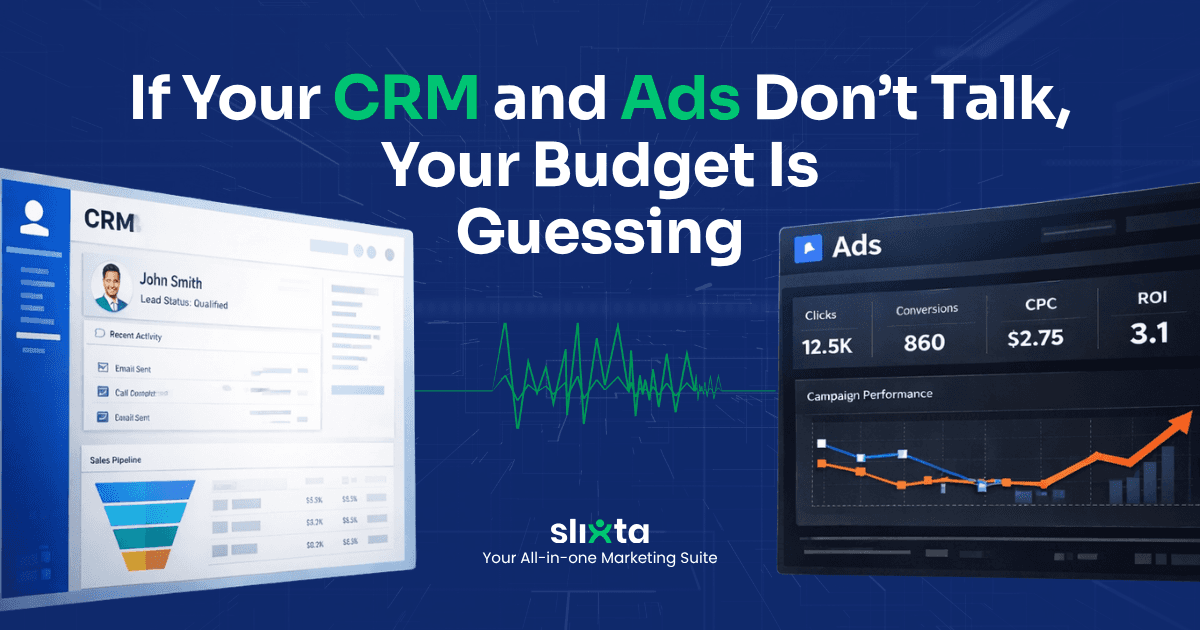
When CRM data and ad platforms stay disconnected, marketing teams lose visibility on which campaigns actually generate real customers, leading to decisions based on incomplete data.
Ads generate attention.
CRM systems record interactions.
In many companies, both systems are running every day.
Campaigns bring people in.
Leads are captured.
Sales teams follow up inside the CRM.
On the surface, the workflow appears complete.
But there is a subtle gap that often goes unnoticed.
These systems usually operate side by side, not together.
Advertising platforms track campaign activity. CRM platforms track the lead journey. Yet the information rarely flows back and forth in a way that helps both systems learn from each other.
When that connection is missing, a large part of the revenue story remains invisible.
And when the system cannot see the full story, marketing budgets start relying on guesses rather than evidence.
Two Systems Observing Different Moments
Advertising platforms are designed to measure the beginning of the journey.
They track impressions, clicks, and the moment a visitor fills out a form or submits contact details. These signals help marketers understand whether a campaign is generating interest.
CRM systems, on the other hand, observe everything that happens after that first interaction.
They record conversations, qualification notes, meeting schedules, deal stages, and final outcomes. The CRM captures context that advertising platforms rarely see.
For example, inside the CRM a sales team may identify whether a lead represents a real buying opportunity or simply early curiosity. They may learn whether the lead belongs to the right industry, whether decision makers are involved, and whether the deal progresses toward a close.
These insights shape how the business evaluates lead quality.
But unless this information flows back to advertising platforms, campaign optimization never learns from it.
When Campaigns Optimize for the Surface
Advertising algorithms rely on signals.
The stronger and clearer the signals, the better those algorithms become at finding similar prospects.
In many setups, the primary signal available is the initial conversion event such as a form submission.
From the advertising system’s perspective, every form submission looks identical. A high intent buyer and a casual browser both appear as successful conversions.
Because the system cannot see deeper outcomes, optimization focuses on generating more of the same early signals.
Campaigns that produce large numbers of leads are rewarded. Campaigns that generate fewer responses receive less visibility.
Over time, the algorithm becomes very efficient at finding people who are willing to submit forms.
But that does not necessarily mean it is finding people who are ready to buy.
The Quiet Distortion in Performance Metrics
This is where a subtle distortion appears in marketing metrics.
Dashboards may show strong campaign performance. Lead volume increases. Cost per lead improves. Reports suggest that marketing efficiency is rising.
Meanwhile, the sales team may experience something different.
Leads may respond less often. Qualification rates may drop. Deals may stall earlier in the pipeline.
The problem is not always the campaign itself. The problem is the signal being used to judge it.
When cost per lead becomes the main optimization metric, the system gradually favors campaigns that produce responses rather than campaigns that produce customers.
Without CRM feedback, advertising platforms cannot see the difference.
The Missing Feedback Loop
Every effective system improves through feedback.
If certain campaigns consistently produce customers, the system should recognize that pattern and allocate more resources to those campaigns. If other campaigns generate interest but rarely convert, the system should gradually reduce their influence.
But this type of learning only happens when outcomes flow back into the optimization process.
When CRM data remains isolated, the advertising system loses its ability to learn from real results.
High intent leads and low intent leads look identical at the ad level.Budgets scale based on surface metrics.Revenue patterns remain unclear.
Over time, this disconnect makes it harder to understand which marketing activities are truly driving growth.
What Becomes Visible When Systems Connect
When advertising data and CRM data are connected, a much clearer picture begins to emerge.
Campaigns are no longer evaluated only by how many leads they generate. They can also be evaluated by what happens to those leads afterward.
Some campaigns may consistently produce prospects who book meetings quickly. Others may generate leads that require longer nurturing before becoming opportunities. Some sources may convert reliably in certain locations while performing poorly in others.
These patterns are difficult to detect when systems operate independently.
Once the data is connected, they become much easier to see.
Marketing teams can observe how different journeys unfold across campaigns. Sales teams can understand which marketing sources generate the most serious prospects.
Instead of focusing on isolated events, the organization begins to understand the full path from first click to final outcome.
When Budget Decisions Become Evidence Based
Connecting advertising performance with CRM outcomes changes how budget decisions are made.
Instead of scaling campaigns purely based on lead volume, marketers can analyze which campaigns produce leads that actually move through the pipeline.
Budgets can shift toward sources that generate qualified opportunities. Campaigns that produce activity without meaningful progress can be reevaluated.
This creates a more stable optimization process.
Campaigns learn which sources close faster.Which locations convert better.Which journeys stall before reaching a decision.
As these insights accumulate, advertising strategies become more precise. Marketing investment begins reflecting real conversion behavior rather than initial responses.
Bringing the Journey Into One View
The challenge for many organizations is not a lack of data. It is the separation of data across systems.
Advertising platforms know where the lead originated. CRM platforms know what happened after the lead arrived. But without a shared view, these insights remain fragmented.
Bringing these pieces together creates a continuous feedback loop where marketing and sales learn from the same information.
Campaign activity becomes connected to real outcomes. Lead journeys become visible from the first click to the final conversion.
This is where optimization becomes much sharper.
How Slixta Connects the Picture
Slixta is designed to connect advertising performance with the lead journey inside one system.
Instead of treating campaign activity and CRM interactions as separate streams of data, Slixta links them together. Advertising sources, lead routing, qualification signals, and final outcomes are visible within the same environment.
This unified view allows teams to understand not only where leads come from but also how those leads progress through the sales process.
Optimization then reflects real conversions rather than just early responses.
Campaign insights become clearer. Budget decisions become more confident. And the entire system learns from outcomes rather than assumptions.
The Real Difference
Advertising platforms are powerful when they receive the right signals.
CRM systems contain many of those signals because they record the full story of the lead journey.
When these systems remain disconnected, that story is incomplete. High value prospects and low intent inquiries look the same at the campaign level.
But when the systems work together, the difference becomes visible.
And when the difference becomes visible, marketing stops guessing and starts learning from real results.