
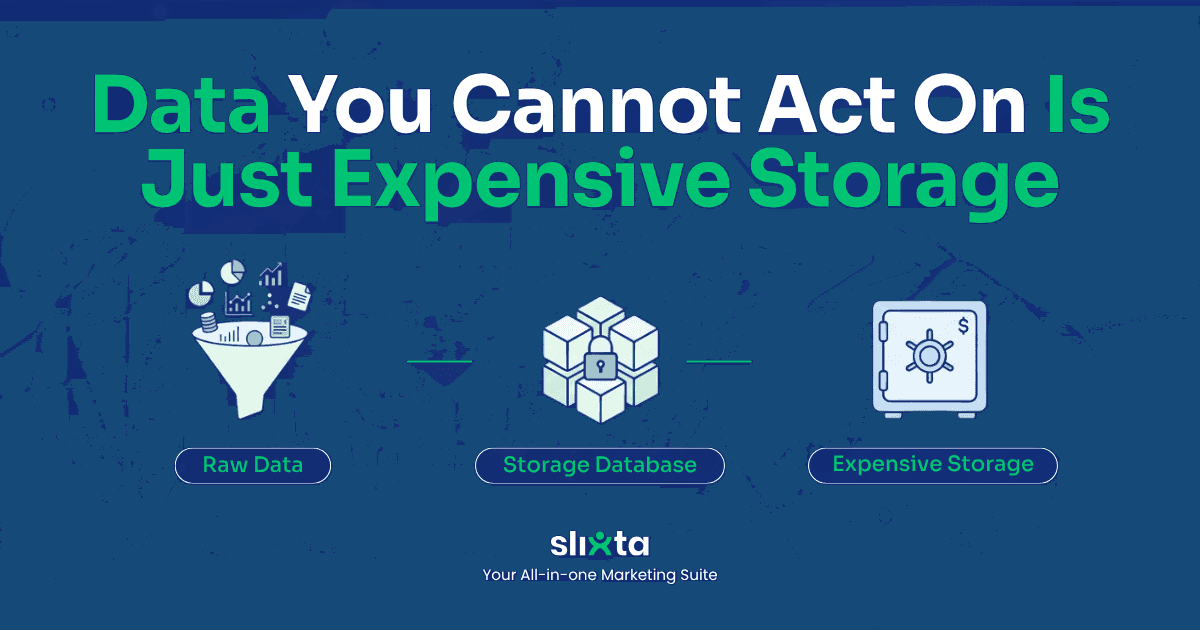
Collecting more data does not guarantee better decisions. When insights are not tied to clear actions, teams stay informed but struggle to improve performance or move faster.
A library can contain thousands of books, each filled with valuable knowledge. But if someone walks in looking for a specific answer and cannot find the right information quickly, the sheer volume of material becomes overwhelming rather than helpful.
Marketing data is beginning to face a similar challenge.
Businesses today collect more information than ever before. Campaign dashboards track performance across multiple channels, platforms, and touchpoints but clarity does not always follow visibility.
Yet many teams still struggle with a simple but critical question:
What should we change now?
When data only describes activity, it keeps teams informed but not directed.
At that point, data stops being a decision tool and starts becoming something else - expensive storage
The Modern Marketing Paradox: Measured but Not Directed
Marketing has never been more measurable.
Today, every stage of a campaign can be tracked, from the moment an ad is displayed to the moment a lead fills out a form, clicks a message, or visits a website.In theory, this level of visibility should make marketing decisions easier.
But many teams experience the opposite.
They are surrounded by metrics yet still uncertain about where to act. Reports explain what happened - impressions increased, engagement held steady, lead generation declined, but they rarely reveal the operational cause behind those shifts.
The result is a subtle but important paradox in modern marketing: everything is measured, yet decisions remain unclear.
A campaign may appear successful because engagement is high. Another might look inefficient due to rising acquisition costs, but these numbers only tell part of the story
But the next move is still uncertain.
Turning Analysis into Action
Many marketing teams already have strong analytics in place. Dashboards track campaign performance, reports summarize weekly results, and metrics are reviewed regularly. The problem is rarely the absence of data. The challenge is ensuring that those insights actually influence what the team does next.
Management thinker Peter Drucker famously said, “What gets measured gets managed.” But in practice, measurement only becomes management when metrics are directly linked to decisions and actions.
To make analytics truly useful for business, marketers need to turn insights into operational steps. Some practical shifts help make this happen.
1. Link every key metric to a decision
A metric should not exist just to report performance. It should signal what action needs to be taken.
For example
- If cost per lead increases, review audience targeting or creative relevance
- If website traffic rises but leads remain low, improve the landing page or form experience
- If leads increase but conversions drop, evaluate follow-up speed or qualification
When each metric has a clear response attached to it, dashboards become decision tools rather than reporting tools.
2. Track the entire customer journey
Many marketing reports focus only on campaign performance. But results are shaped by what happens after a lead is generated as well.
For example
- Ads may perform well but landing pages may create friction
- Leads may be generated but sales follow-ups may be delayed
- Interest may exist but conversations may not move forward
Looking at the full journey helps teams identify where performance is actually breaking down.
3. Shorten the feedback loop
Data becomes powerful when it leads to faster adjustments. If performance insights are reviewed weeks later, the opportunity to improve the campaign has already passed.
Operational teams review signals frequently and make small adjustments while campaigns are still running. This allows marketing to evolve continuously rather than waiting for post-campaign analysis.
4. Focus on signals that influence outcomes
Not every metric deserves equal attention. Metrics such as impressions or reach show activity, but metrics closer to business outcomes reveal where improvement matters most.
Prioritizing signals related to lead quality, response time, and conversion behavior helps teams focus on changes that actually improve results.
When these practices are in place, analytics stops functioning as a record of past activity. It becomes a system that continuously guides marketing decisions and improves performance.
What Actionable Data Looks Like in Practice
The difference between collecting data and using it becomes clearer when we look at how some companies operate.
At Amazon, customer data does not simply sit inside reports. It shapes the shopping experience in real time. Product recommendations change based on browsing behavior, pricing adjusts according to demand patterns, and inventory decisions respond to purchasing trends. Data is constantly feeding operational decisions.
Across companies like this, the principle is clear- Data is valuable because it moves quickly into action.
For most marketing teams, however, the challenge is not the lack of insight; it is the fragmentation of information. Campaign metrics live in advertising dashboards, lead conversations happen in messaging apps, and conversion data sits inside CRM systems. Each platform shows a piece of the story, but rarely the entire journey.
When these signals remain disconnected, it becomes difficult to understand where performance is actually improving or slowing down. Teams may know how many leads were generated, but not how quickly they were contacted. They may see campaign engagement, but not whether those interactions turned into meaningful conversations or conversions.
Bridging that gap between campaign performance, lead interactions, and outcomes is what ultimately turns marketing data into something truly actionable.
Designing Marketing Systems That Turn Data Into Action
If data is meant to guide decisions, the real question for marketers is not how much information they collect, but how their systems are designed to use it.
In many organizations, data flows into dashboards where teams review campaign performance and discuss trends. But campaign metrics, lead interactions, and conversion outcomes often live in separate tools. Because these signals are fragmented, insights take longer to surface and even longer to translate into action.
Platforms like Slixta are built to close this gap. Instead of treating campaigns, lead engagement, and reporting as isolated layers, Slixta keeps them aligned within a single workflow. Campaign activity, lead journeys, and performance insights stay connected so marketers can see what is happening across the entire journey and move from insight to execution faster.
Which brings us back to the idea we started with.
A library full of books holds immense knowledge, but its value appears only when the right information can be found and used at the right moment.
Marketing data works the same way.
Slixta turns stored information into usable insight so your data does not sit on the shelf, it moves the business forward.