
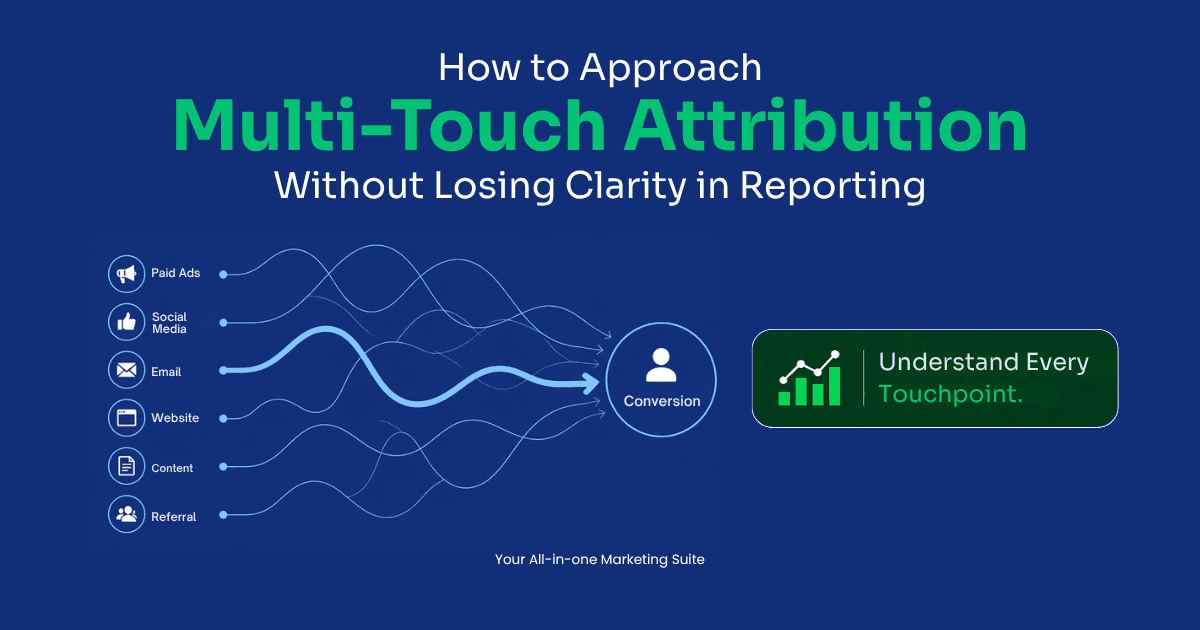
How to Approach Multi-Touch Attribution Without Losing Clarity in Reporting
May 4, 2026
Attribution becomes useful when it focuses on clear outcomes, not complex models. Simplifying tracking and connecting key touchpoints helps teams understand what drives real results and what to do next.
A customer clicks your ad, visits your website, leaves, comes back through another channel, and finally converts.
So what actually made them buy?
Was it the first ad, the retargeting campaign, the landing page, or the final conversation?
This is the problem attribution is trying to solve.
Attribution in marketing is often discussed as if it were a technical problem, something that can be solved with better tools, more data, or more advanced models. In reality, attribution is much simpler in concept and far more complex in practice.
At its core, attribution is about answering one fundamental question: what influenced a customer to take action?
When someone becomes a lead, books a demo, or makes a purchase, that decision is rarely the result of a single interaction. It is shaped by a series of touchpoints over time, an ad they noticed, a website they explored, a conversation they had, or even a recommendation they received.
Why Attribution Breaks Down in Practice
Attribution doesn’t get complicated because customer journeys are complex. It gets complicated because we try to explain too much with too much precision.
A user doesn’t think in channels. They don’t distinguish between paid, organic, or direct traffic. They are simply exploring, comparing, and deciding. But the moment we try to translate that behavior into reports, we break it into pieces- clicks, sessions, sources, campaigns and then try to assign credit to each one.
That’s where the disconnect begins.
What was originally a fluid decision-making process becomes a fragmented dataset. One interaction gets labeled as “first touch,” another as “last touch,” and everything in between gets distributed across models that attempt to be fair, but rarely reflect reality.
The more touchpoints you track, the more fragmented the picture becomes.
And instead of getting closer to understanding what influenced the decision, you end up debating which model to trust, rather than what the customer actually did.
This is why many attribution systems feel sophisticated but fail to guide action. They explain the journey in detail, but they don’t clearly tell you what to do next.
What Actually Works: Bringing Clarity Back to Attribution
If attribution breaks down when we try to explain everything, the solution is not better models. It is a better structure.
Clarity in attribution does not come from tracking more. It comes from deciding what matters and organizing everything around it.
- The first step is defining a single, primary conversion goal. Most teams try to measure everything, clicks, visits, engagement, leads, pipeline and end up understanding nothing clearly. Instead, pick what truly matters: a qualified lead, a booked visit, or a sale. Every attribution effort should connect back to this one outcome. For example, instead of asking which campaign generated the most traffic, ask which campaign generated the most qualified demos. That shift alone eliminates a large amount of noise.
- Once the goal is clear, the next step is tracking the full journey without overloading reporting. Users will always interact with multiple touchpoints, and that complexity is real. But reporting does not need to reflect that complexity in full. The journey can remain detailed in the backend, while the front-end view stays simple and usable. A structure like source → conversion → outcome is often enough to make decisions.
- Another critical shift is connecting attribution with actual outcomes, not just activity. Clicks and impressions indicate that something is happening, but they do not indicate whether anything meaningful is happening. A campaign generating thousands of clicks with no conversations is far less valuable than one generating fewer clicks but consistent qualified leads. Attribution only becomes useful when it answers what happened after the lead was captured did they respond, engage, convert, or drop off?
- It is also important to avoid over-crediting every touchpoint. Not every interaction deserves equal weight, and trying to assign perfect credit often leads to misleading conclusions. Instead, focus on patterns. For example, you may find that Google Search consistently initiates high-intent journeys, while remarketing campaigns or direct visits tend to close them. That insight is far more actionable than dividing credit evenly across all interactions.
Finally, reporting must remain decision-focused. Every attribution report should answer a simple question: what should change next? If a channel is consistently driving high-quality outcomes, it deserves more investment. If another channel is generating volume without results, it needs to be reworked or reduced. If a report does not lead to a clear action, it is not helping, it is simply adding noise.
Attribution That Actually Moves the Business
Attribution does not fail because of a lack of data. It fails when data stops guiding decisions.
Most systems today are built to explain journeys in detail, but very few are built to clearly show what is working and what should happen next. As channels multiply and customer paths become less predictable, trying to track everything only adds more complexity without improving clarity.
The advantage will belong to teams that simplify.
Teams that define one clear outcome, focus on the moments that actually influence decisions, and build systems that connect those moments instead of fragmenting them.
This is where Slixta fits in.
Slixta focuses on the touchpoints that actually influence decisions, primarily where leads are captured and where conversations happen. Instead of trying to track every possible interaction, it connects key sources such as ads, landing pages, and channels like WhatsApp directly with lead journeys, routing, and outcomes inside the CRM.
This creates a clearer view of attribution. Not just where leads came from, but what actually happened after, whether they engaged, moved forward, or converted. The visibility is enough to understand which channels are driving real outcomes, without overcomplicating reporting with incomplete or unreliable data.
Because attribution becomes useful when it guides action, not when it explains everything.
Slixta connects campaigns, conversations, and outcomes into a single flow, so teams can move beyond tracking and start understanding what truly drives growth.
And in the end, that is the shift that matters.
Not more data. Not more dashboards.
Just clarity on what works and the confidence to do more of it.