
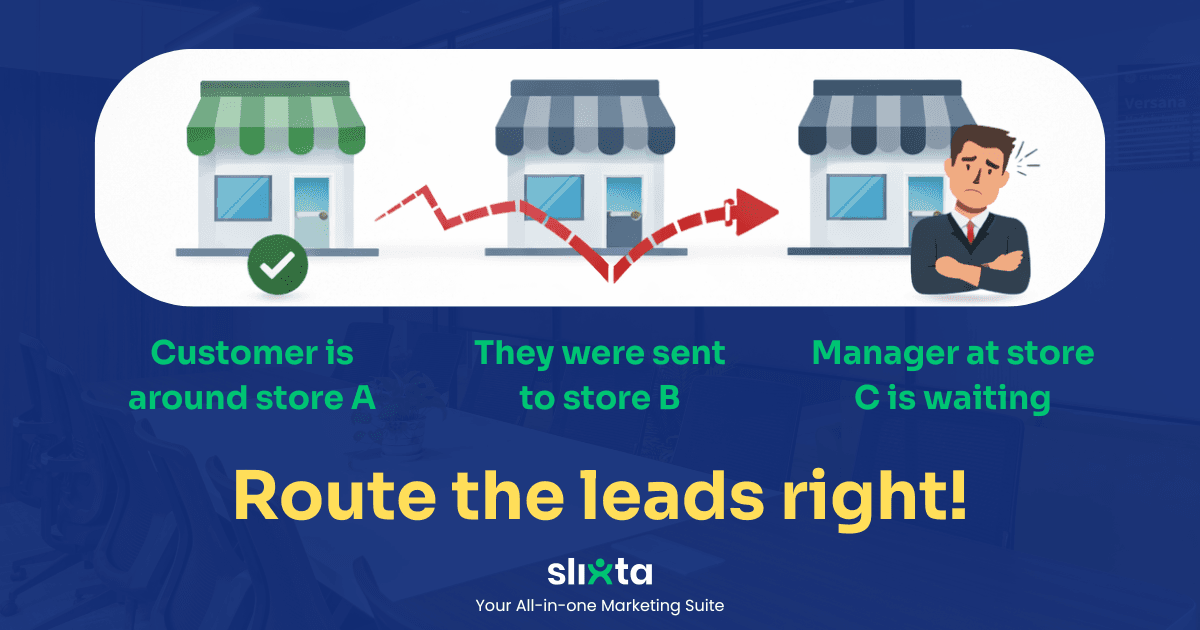
The Customer Picked Store A. Your Team Sent Them to Store B. And the Manager at Store C Is Waiting. When customer intent, internal systems, and local teams fall out of sync, conversions suffer quietly.
The Silent Killer of Conversion
In multi-location retail and services, there is a silent killer of conversion that most marketers ignore. We call it The Synchronization Gap. It’s the operational "black hole" where a customer explicitly picks Store A, your central team mistakenly routes the lead to Store B. At the same time, the manager at Store C sits staring at a blank dashboard, waiting for a lead that will never arrive.
This isn't just a minor technical glitch; it is a customer experience crisis. As Steve Jobs once famously said: "You’ve got to start with the customer experience and work back toward the technology, not the other way around." When your internal execution ignores a customer’s local intent, you are letting outdated technology ruin a relationship before it even begins.
The Infrastructure of Confusion: Why Store B and C are Stuck in Limbo
When internal execution is out of sync with customer intent, it isn't just a communication gap: it is a structural failure. The reason Store B is overwhelmed with irrelevant inquiries while the team at Store C is left waiting for data that never arrives comes down to four critical operational breakdowns:
Operational Blindness
Without a unified, real-time dashboard, local managers are essentially flying blind. Store C may see a generic notification to "follow up with new leads," but because the routing logic is broken, they are looking for prospects who aren't even in their territory. Meanwhile, the high-priority lead that specifically requested Store A sits untouched in a central inbox.
The Fragmented Channel Trap
In a multi-location setup, leads pour in from a dozen directions: WhatsApp API, Google Business Profiles (GMB), local landing pages, and web forms. When these aren't funneled into a single source of truth, local teams spend more time hunting for information across different apps than actually talking to customers.
Contextual Decay
This is where the sale is often lost. When a lead is passed manually from a central marketing team to a local branch, the "why" behind the interest often disappears. Store B might receive a name and a phone number, but they lose the critical context: that the customer was responding to a specific limited-time promotion intended for Store A.
The Opportunity Cost of Misalignment
Misrouting a lead doesn't just delay the response; it destroys the relevance of the conversation. By the time Store B realizes they can't fulfill a request meant for Store A, the customer has already felt the friction of a "broken" brand.
This gap isn’t about your creative messaging or your ad spend; it is about execution after the click.
The McDonald’s Blueprint: Glocalization Through Tech
How does a brand with 40,000+ locations ensure you get the same experience in Berlin as you do in Bangalore, while still feeling "local"? They mastered Glocalization: the practice of conducting business according to both local and global considerations.
The term was popularized in the 1980s by sociologist Roland Robertson and originally derived from the Japanese business concept dochakuka. Today, it has become the gold standard for digital marketing. It is the strategy of "thinking globally and acting locally," ensuring a brand maintains a powerful, unified identity while adapting its soul to the cultural and geographic nuances of a specific neighborhood.
In the digital age, glocalization is the only way to bypass the "uncanny valley" of marketing, where a brand feels too corporate and detached to be trusted by a local buyer.
Localized Digital Assets
McDonald’s doesn't just have a website; they have thousands of localized landing pages. If you search in Tokyo, the interface highlights the Teriyaki Burger; in India, it’s the McAloo Tikki. This ensures the "Click" feels relevant to the user’s immediate environment.
Orchestrated Data
They pioneered the integration of mobile apps with hyper-local geolocation. When you "pick" a store on the app, the kitchen at that specific location receives the order context and inventory data immediately. There is no "Store B" or "Store C" in the middle to muddy the waters.
The Central Brain
McDonald's treats every location as an individual business unit with its own data ecosystem, yet everything is governed by a single, central platform. This is the hallmark of modern digital enablement: empowering the local branch with the sophisticated tools of a global giant.
For the modern marketer, glocalization is no longer an "enterprise-only" luxury. With the rise of Zero-Click searches and Google Business Profiles, your ability to synchronize global brand standards with local execution is the difference between a lead that converts and a lead that vanishes into the Synchronization Gap.
Mastering the “Click” to “Brick” Transition
How do you ensure that a digital "Click" successfully turns into a physical "Brick" sale? It requires a shift from manual pushing to intelligent, behavior-based lead management.
As multi-location businesses scale, complexity doesn’t grow linearly—it compounds. More stores mean more campaigns, more channels, more data, and more handoffs. Without a unified system governing how customer intent flows from click to conversation, even well-run teams end up working in silos. The result is predictable: misrouted leads, delayed responses, lost context, and internal blame cycles.
A unified “brain” is not about control for its own sake; it’s about ensuring that every team, at every location, is operating from the same source of truth — in real time.
Using Slixta to Bridge the Synchronization Gap
High-performing teams adopt a 70/30 framework for their technology and operations, using a centralized platform like Slixta to anchor the entire journey.
70% Centralized Control
Your core brand identity, messaging, and tech tools like CRM and CMS are managed centrally. Slixta acts as this central anchor, capturing leads from GMB, WhatsApp, and web forms, maintaining data ownership, and ensuring no lead gets lost in the shuffle between headquarters and branches.
30% Local Adaptability
Local managers are empowered to respond to reviews, update local hours, and run neighborhood-specific campaigns using approved templates. Slixta supports multi-location lead management, giving each branch full visibility of their relevant leads, and simplifying follow-ups so teams know exactly what they need to act on. No more “waiting at Store C” or blame between marketing and operations.
If your leads are currently bouncing between Store A and Store B while Store C waits in silence, the lesson is simple: your systems are out of sync. High-performing brands don’t rely on manual handoffs, and neither should you.
Use Slixta to unify local campaigns, capture leads effectively, and give branch managers the visibility they need to win. Switch to Slixta. Stop the chaos.