
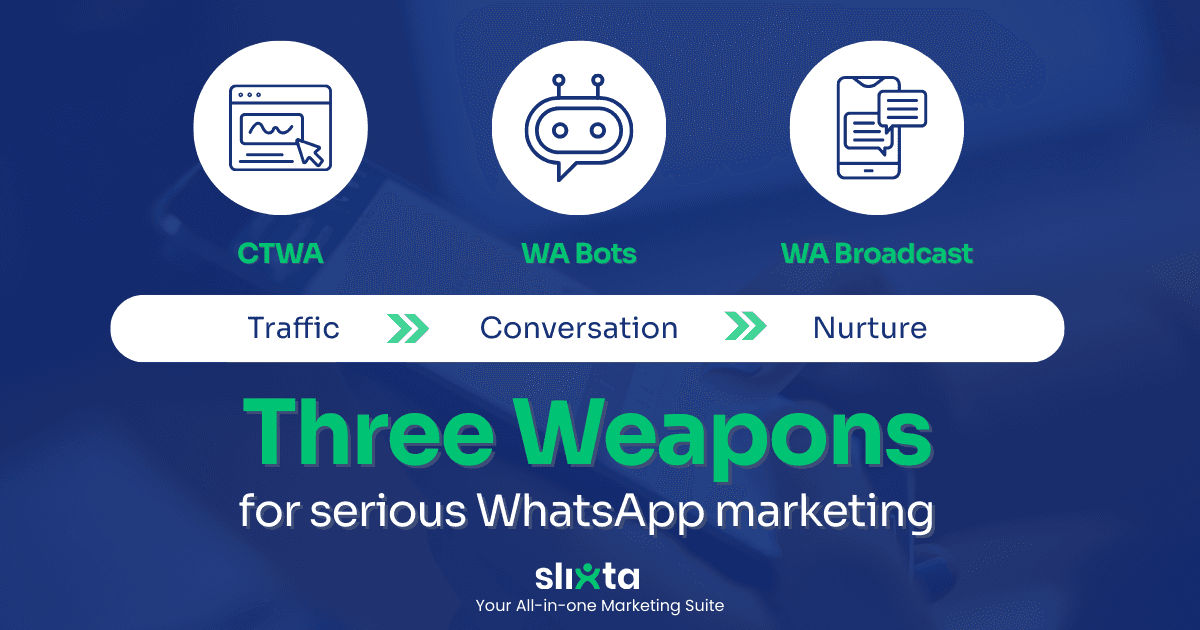
Three Weapons For Serious WhatsApp Marketing, WA Broadcast, WA Bots, CTWA
Jan 26, 2026
WA Broadcast, WA Bots, and Click to WhatsApp Ads give businesses three powerful ways to start conversations, automate responses, and turn WhatsApp into a consistent lead and sales channel.
Most teams treat WhatsApp marketing like construction without a blueprint.
They lay bricks.
Maybe install a door.
And call it a building.
Running only CTWA ads is like building a grand entrance with nothing behind it.
You generate traffic, people walk in, and find an empty space.
Installing a bot without a traffic engine is like building rooms no one ever visits.
Efficient? Maybe.
Occupied? No.
Sending broadcasts without structure is like repainting the same unfinished house every week and hoping it increases property value.
CTWA, Bots, and Broadcast aren’t decorative elements.They’re structural components.
Miss one, and the structure weakens.Use all three together, and you don’t just build campaigns but you build infrastructure.
CTWA: The Entry Point That Actually Converts Attention
Click-to-WhatsApp Ads (CTWA) are often evaluated using traditional performance metrics - CTR, CPC, cost per lead. But measuring them purely as an ad format misses their strategic role inside the funnel.
CTWA is not just a traffic driver. It is a friction reducer.
In a conventional performance flow, the user moves from ad to landing page, from landing page to form, from form to confirmation, and only then to follow-up. Each step introduces delay, distraction, and drop-off. The funnel is technically structured, but psychologically fragile.
CTWA compresses that journey.
Instead of asking the user to read, scroll, evaluate, and submit, it opens a direct line of communication the moment interest is triggered. That compression shifts the dynamic from passive browsing to active engagement. The user is no longer consuming information — they are entering a conversation.
Strategically, CTWA works best in three scenarios:
- High-consideration decisions
Real estate, education, healthcare, B2B services — categories where buyers have questions before commitment. A conversation reduces uncertainty faster than a static page. - Price-sensitive markets
When users click on pricing-focused creatives, they often want clarification, not a sales call. CTWA captures that micro-intent immediately. - Mobile-first audiences
On mobile, friction tolerance is lower. Switching tabs, filling forms, waiting for email follow-ups each step reduces momentum. A direct chat keeps the user inside one interface.
When used correctly, CTWA doesn’t just generate leads. It transfers intent directly into a live conversation.
But conversation velocity only matters if there is a system ready to handle it. Because attention without handling capacity creates bottlenecks — and in high-intent channels like WhatsApp, delay is the fastest way to lose momentum.
Bots: The System That Protects Momentum
CTWA may start the conversation, but the real risk begins after the click. In high-intent channels like WhatsApp, response speed directly affects outcomes. Studies across digital channels consistently show that faster first responses significantly increase qualification rates and downstream conversions.
Intent has a half-life.
If conversations wait in an inbox, momentum decays.Once momentum drops, recovering it is far more expensive than maintaining it. What was curiosity turns into distraction. What was urgency turns into comparison shopping.
Bots exist to prevent that decay.
Not as generic auto-replies but as structured qualification systems that stabilize the funnel at scale.
First, bots capture essential signals the moment a conversation begins — intent, urgency, budget range, location, use case.
If 200 people click your CTWA ad in a day, that is 200 conversations that need direction. Without structure, your team manually qualifies all 200. With automation, only the 40 high-intent prospects are escalated to sales, while the remaining 160 are guided, educated, or nurtured appropriately.
Bots turn raw attention into categorized opportunity.
They maintain speed at scale, Humans respond sequentially. Bots respond simultaneously. Whether 20 conversations start or 2,000 do, response speed remains consistent.
CTWA captures attention. Bots stabilize momentum.
But momentum alone doesn’t build revenue. Continuity does. And continuity on WhatsApp is powered by Broadcast.
Broadcast: The Layer Most Teams Misuse
Here’s the uncomfortable truth:
Most teams use WhatsApp Broadcast like email.
Same blast. Same list. Same hope.
But WhatsApp isn’t built for noise. It’s built for continuity.
After CTWA captures attention and bots stabilize momentum, there’s a gap most funnels ignore the space between “not yet” and “ready.”
That space is where revenue quietly accumulates.
Broadcast, when structured properly, does not interrupt. It reinforces. This is especially critical in high-consideration markets. People compare. They pause. They evaluate internally. If you disappear during that window, competitors don’t.
But if you remain contextually present not pushy, not random, but relevant you stay in the decision frame.
The real strategic shift is this: Broadcast is not about sending updates. It’s about designing progression.
Most teams plan messages in isolation. Effective teams design sequences. Instead of asking, “What should we send today?” they ask, “What should this segment hear next?”
Broadcast becomes powerful when it continues a journey — not when it restarts attention.
Strategically, effective Broadcast depends on three disciplines:
- Segment before you send. Every message should correspond to a stage, an intent level, or a recent behavior. If you can’t clearly define who it’s for, it shouldn’t go out.
- Sequence, don’t spam. Messages should build on each other - clarification → proof → reminder → trigger, instead of repeating the same push.
- Protect timing. The closer a message is to expressing interest, the higher its impact. Delay turns intent into indifference.
When the Three Weapons Work as One
CTWA brings attention.Bots protect momentum.Broadcast sustains relevance.
But none of them reach their full potential in isolation.
For WhatsApp to function as a true marketing system, three layers must stay connected beneath the surface:
- Acquisition context - every conversation carries its source, campaign, and original intent.
- Behavior tracking - replies, clicks, and drop-offs continuously update the contact profile.
- Segment automation - audiences evolve automatically as user behavior changes.
This is the difference between using WhatsApp tactically and using it structurally.
When acquisition context is preserved, a pricing click doesn’t get treated like an awareness inquiry.When behavior tracking is live, bots don’t just respond - they classify.When segmentation is automated, Broadcast doesn’t guess - it aligns.
This is where Slixta wires the system together.
Instead of running CTWA, bots, and Broadcast as disconnected tools, Slixta connects them through a unified data layer. Every ad click, conversation, reply, and interaction feeds into one evolving profile. Qualification informs nurture. Nurture informs re-engagement. Each action strengthens the next.
The result isn’t more messaging.
It’s coordinated momentum.
CTWA captures.
Bots qualify.
Broadcast compounds.
And Slixta makes sure they operate as one infrastructure, not three separate efforts