
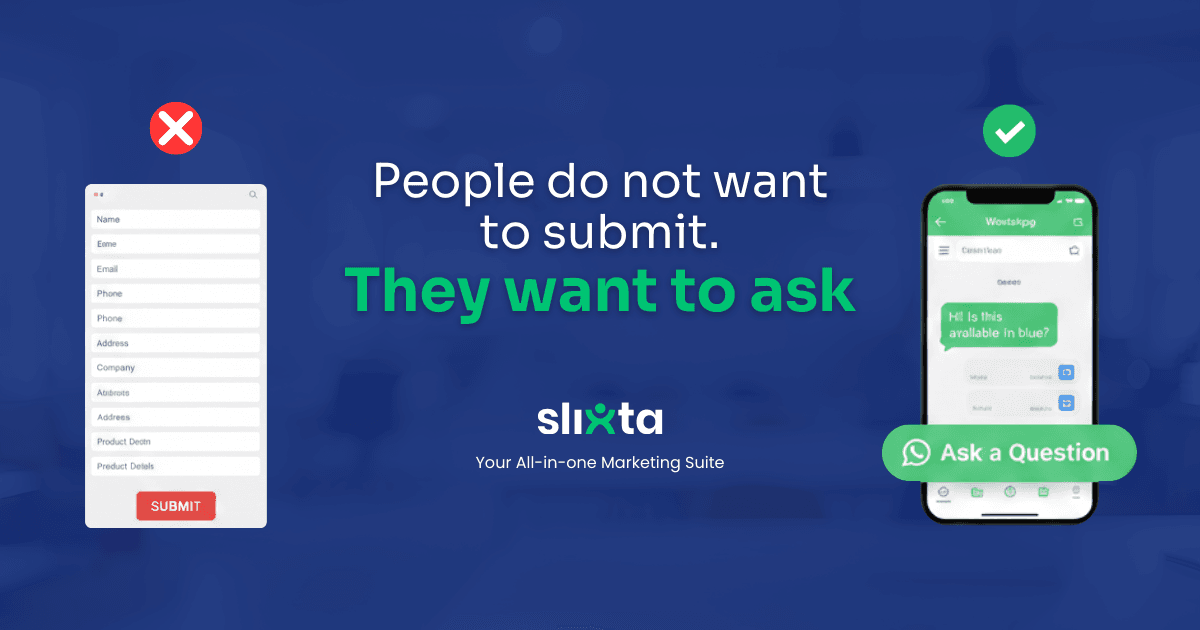
Buyers no longer rush to submit forms. They prefer asking questions first, seeking clarity before commitment, and choosing conversation over rigid funnels in a low-trust environment.
Imagine opening Netflix to check out a new show everyone’s talking about. Before you can even watch the trailer, a pop-up blocks the screen asking for your full details and a survey about your viewing preferences.
You’d probably close the app.
You just wanted to see if it was worth your time.
That hypothetical scenario sounds absurd in entertainment. Yet in marketing, we do something similar every day. Buyers click with curiosity, and before they get clarity, we ask for commitment.
In 2026, that dynamic no longer works. People do not want to submit. They want to ask.
The 2026 Buyer Mindset: Conversation Before Commitment
We are no longer in the decade of “Submit to Continue.” We are in the era of conversation-first decision making.
Modern consumers especially in high-consideration purchases like real estate, education, healthcare, B2B services, or premium D2C won’t move linearly through funnels anymore. They move cautiously. Iteratively. They explore before they engage.
Behavioral psychology explains this clearly.
Daniel Kahneman, Nobel Prize–winning psychologist, described how humans are loss-averse. We fear negative outcomes more than we value potential gains. Clicking “Submit” subconsciously signals a loss of control: “Now they have my details. Now they’ll call. Now I’m in the system.”
That anticipation creates friction.
Today’s buyer prefers something that feels lighter.
They want to ask before they agree. Clarify before they commit. Test responsiveness before they trust.
This is not indecisiveness. It is risk management.
We’re operating in what many analysts describe as a low-trust digital economy. Spam fatigue, aggressive follow-ups, and data privacy awareness have trained users to guard their contact details carefully.
When the Front Door Changes, the Funnel Must Too
Once you accept that buyers want dialogue before commitment, a bigger question emerges: what happens to the funnel itself?
Most marketing frameworks still follow AIDA. Attention leads to Interest. Interest should build Desire. Desire should lead to Action. The model still works. What often breaks is the pacing.
Today, an ad captures Attention. A landing page sparks Interest. And almost immediately, we push for Action through a form. The stage where Desire should develop gets rushed.
Curiosity is often mistaken for buying intent.
But being interested is not the same as being ready. Interest says, “This looks useful.” Desire says, “I want this.” That shift happens when questions are answered and doubts are cleared. When we demand Action before that transition, we interrupt the process instead of guiding it.
This is why the front door is changing.
Increasingly, users are choosing messaging platforms as their first point of contact. Not because they want to chat casually but A messaging window offers three psychological comforts that forms don’t:
- Control – The user decides when to respond and how much to share.
- Context – They can explain their specific needs instead of fitting into predefined fields.
- Continuity – The conversation doesn’t disappear after one interaction.
In markets like India, Southeast Asia, the Middle East, and parts of Europe, WhatsApp has effectively become a business interface. It’s no longer just a social app; it’s where inquiries, negotiations, confirmations, and even purchases begin.
For marketers, this creates both an opportunity and a challenge.
The opportunity: lower friction at the top of the funnel.
The challenge: how do you maintain attribution, structure, and qualification when entry happens through conversation instead of a form?
Structuring Conversations Without Breaking the Experience
If conversation is becoming the new entry point, the real challenge isn’t enabling it. It’s organizing it.
Many businesses experiment with messaging-led campaigns and quickly encounter operational friction.Conversations increase, but clarity decreases.Teams struggle to see where leads came from, what triggered the inquiry, how qualified the prospect is, and who should take ownership. Follow-ups become inconsistent, and context gets lost.
Without proper routing and tagging, messaging can become fragmented. Sales teams are forced to ask repetitive qualifying questions. Marketing teams struggle with attribution. Leadership loses visibility into performance metrics.
In other words, the user experience improves but backend clarity suffers.
This is the structural gap platforms like Slixta are designed to solve.
Instead of pushing users toward static forms, Slixta allows ad clicks to flow directly into structured conversations. Behind the scenes, each inquiry is automatically mapped to its originating campaign, ad set, and source. Context travels with the conversation.
So when a sales representative opens a chat, they already know: Which campaign drove the lead, What messaging influenced the click, What intent signal triggered the interaction.
Follow-ups happen inside the same thread, preserving history and nuance. Leads can be categorized, tracked, and qualified without forcing the buyer into a rigid submission process.
From the buyer’s perspective, it feels effortless and from the business perspective, it remains measurable, attributable, and operationally controlled.
Buyers have changed. Entry points have changed. The only question is whether your system has. Slixta ensures conversation doesn’t create chaos; it creates clarity.