
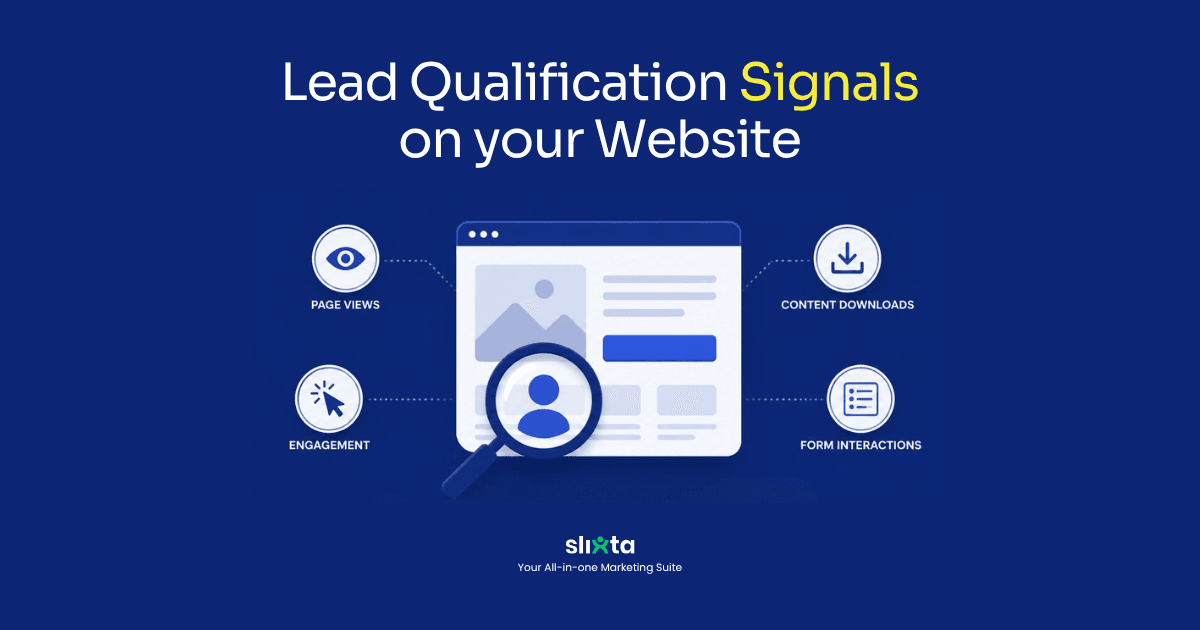
Your website reveals buying intent long before a visitor fills out a form. By tracking behavioral signals like traffic source, content viewed, engagement, and return visits, businesses can identify high-intent prospects earlier and respond at the right time.
The average person now spends close to seven hours a day looking at a screen. Reels, shorts, push notifications, and an endless stream of ads compete for every spare moment. The internet has become an attention economy and attention, unlike clicks, is expensive to earn.
That shift changes how businesses should think about website visitors.
A click is easy to generate. Sustained attention is not. When someone chooses to stay on a page, dig into a comparison, download a resource, or come back a second and third time, they're revealing far more than passing curiosity. They're leaving behind lead qualification signals, behavioral evidence of where they actually sit in the buying journey, often weeks before they ever fill out a form.
Most businesses still wait for that form. They qualify leads only after a name lands in the CRM which means the website has already done half the work, unread.
Here's how to start reading it.
1. Traffic Source: The First Layer of Intent
Every visitor arrives carrying context, and where they came from is the first clue to why.
- Organic search usually signals active research around a specific problem or solution.
- Direct traffic suggests existing brand familiarity or a returning need.
- Referral traffic carries built-in credibility, borrowed from a trusted third party.
- Paid campaigns vary widely in intent depending on the keywords, audience, and offer behind them.
- Social media often reflects early-stage discovery, though thought leadership content can pull in prospects who are further along than the channel's reputation suggests.
Traffic source alone doesn't determine lead quality. But it sets the baseline for interpreting everything that happens next.
2. Content Consumption: What Stage Are They Really In?
The pages someone visits tend to mirror the questions they're trying to answer.
Educational, top-of-funnel content usually signals problem exploration. Product and service pages suggest active solution evaluation. Pricing pages, implementation guides, integration docs, and customer case studies typically mean a decision is getting closer and the visitor is no longer asking "what's the problem?" but "will this work for us?"
Looking at individual pages tells part of the story. Looking at the sequence of pages the path someone takes from your post to a pricing page tells you far more about buying intent than any single page view.
Instead of asking prospects to declare their intent, businesses can begin observing how that intent develops naturally over time.
3. Engagement Quality: Attention is harder to fake than clicks
Engagement is a stronger qualification signal because it captures the quality of an interaction, not just its existence.
A click can happen because of curiosity, habit, or even accident. Meaningful engagement requires something different: time, focus, and enough perceived value for someone to keep investing their attention.
Signals worth tracking include:
- Time on page
- Scroll depth
- Multiple page views in a single session
- Content downloaded
- CTA interactions
- Return sessions
No single metric qualifies a lead on its own. But layered together, they build a far more reliable read on intent than traffic volume ever will.
4. Return Visits: Familiarity Builds Confidence
In 1968, psychologist Robert Zajonc introduced the mere exposure effect, showing that repeated exposure to something naturally increases familiarity and trust even without new information being added each time.
Buying decisions tend to follow the same pattern. Meaningful purchases rarely happen after a single interaction; confidence builds gradually, as questions get answered and uncertainty narrows.
It means return visits should be read alongside traffic source, content consumed, and engagement quality. Qualification gets more accurate as more signals are considered together, not in isolation.
5. First-Party Intent Is Becoming a Competitive Advantage
As third-party cookies phase out and privacy expectations tighten, first-party data is becoming one of the most valuable assets a business owns.
Unlike purchased audience segments or inferred, third-party intent data, first-party behavioral signals come directly from interactions with your own website. They reflect genuine interest, belong entirely to your business, and carry context that no external data provider can replicate.
For many organizations, this data has been sitting in analytics dashboards for years underused, not because it lacks value, but because no one has connected it to what sales and marketing do next.
The Real Gap Isn't Data. It's Action.
Most businesses already collect plenty of website data. Analytics platforms measure engagement. Marketing tools log conversions. CRMs track opportunities.
Visibility isn't the problem. Execution is.
Behavioral insight routinely stays trapped in dashboards and reports instead of shaping lead qualification, follow-up timing, or sales prioritization. The signals get collected every day and every lead still gets treated the same way once it hits the CRM.
This is where a new generation of marketing platforms is beginning to change the conversation. Rather than waiting for a form submission to trigger action, they're helping businesses respond to behavioral signals while buying intent is still developing. Slixta is one example of this broader shift, connecting website behavior with CRM workflows and customer journeys so engagement can influence follow-up, not just reporting.The technology itself isn't the story. The bigger shift is that businesses are beginning to qualify intent through observed behavior instead of relying entirely on declared information.
The advantage doesn't come from collecting more data, it comes from acting on the data already sitting in your stack.
Your Website Is Already Qualifying Leads
The next competitive advantage won't come from generating more leads.
It will come from recognizing the difference between attention and intent and responding before everyone else does.
Your website has never been just a destination for visitors. It's been a conversation happening in behavior rather than words. Every scroll, return visit, comparison, and moment of attention adds another sentence to that conversation.
The businesses that learn to listen won't just qualify better leads.
They'll arrive at the buying decision alongside their customers, instead of after it.