
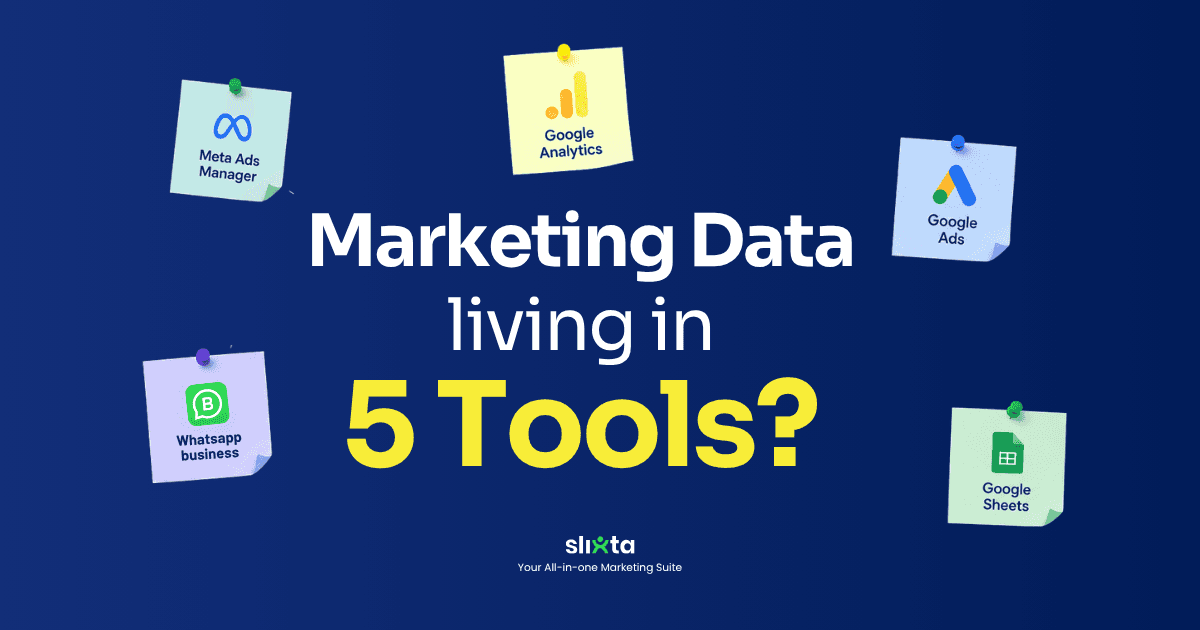
Information alone doesn't drive growth. Connected context does. Slixta brings marketing, sales, and customer data into one view, helping teams understand which campaigns actually generate revenue instead of reconciling disconnected reports.
There's an old parable about several blind men describing an elephant.
One touches the trunk and says it's a snake. Another touches the leg and says it's a pillar. A third feels the tail and insists it's a rope.
None of them are lying. They're simply experiencing different parts of the same reality.
Marketing teams often do the same thing with data.
Google Analytics is open. Meta Ads Manager is open. The CRM report lives inside a spreadsheet someone exported last Tuesday. Google Ads sits in another tab. WhatsApp follow-up numbers exist only in a sales rep's head.
Every number is technically available.
None of it is connected.
Which is why most organizations don't have a data problem.
They have a context problem.
Where Is the Knowledge We Have Lost in Information?
Poet T. S. Eliot once asked, "Where is the knowledge we have lost in information?"
Nearly a century later, the question feels less poetic and more operational.
Modern businesses have no shortage of information. Website traffic tells us who showed up. Ad platforms tell us what brought them. CRM systems tell us what happened afterward. Every team has access to numbers. Every dashboard has charts.
And yet, when leadership asks a deceptively simple question, "what's driving revenue this month," the answer is rarely immediate.
Not because the data doesn't exist.
But because information and understanding are not the same thing.
Knowing that a campaign generated 5,000 clicks is information.
Knowing that those clicks produced three customers is knowledge.
And knowing why those customers converted while hundreds of others didn't, that is understanding.
Somewhere between collecting information and creating understanding, context gets lost.
Which is why organizations often find themselves drowning in metrics while starving for clarity.
The problem isn't the absence of data.
It's the absence of a shared story that connects it.
Information is what happened. Knowledge is what it means. Understanding is what to do next.
Most marketing stacks today stop at the first rung.
The Hidden Cost of Parallel Truths
Metrics quietly become substitutes for outcomes.
A click becomes the stand in for interest. A qualified lead becomes the stand in for revenue. An open rate becomes the stand in for relevance. Each one starts as a useful signal, then slowly turns into the thing itself, simply because it's the only thing the system can actually show.
The system decides which questions you're even able to ask.
A dashboard that only shows clicks will only ever produce questions about clicks. A CRM that stops at "lead created" will only ever produce questions about lead volume. Nobody sits down and decides to ignore revenue. The tool simply never asked. And when revenue isn't visible, you don't end up with no answer. You end up with a confident, wrong one, built entirely out of whatever happened to be visible at the time.
Speed dies in the time it takes to reconcile.
Every fragmented system needs a translator. Someone has to open five tabs, line up the numbers, and decide whose version of the truth to trust today. That translation isn't free. It costs the one resource that matters most while a lead is still warm: time.
By the time marketing's truth and sales' truth get reconciled into one version everyone agrees on, the moment that actually needed it, the follow up, the budget call, the conversation that had to happen this week, has usually already passed. Nothing was lost because anyone was slow. It was lost in translation.
What the Elephant Actually Looks Like
The blind men in the parable never resolve their disagreement, because nobody ever lets them compare notes. Each one keeps touching his own piece of the same animal, certain he has the whole picture.
Marketing teams do something similar, except the animal is the customer journey, and the five senses are five separate tools.
Marketing touches the trunk and reports back: engagement is up, the campaign worked.
Sales touches the tail and reports back: the leads were thin, nothing closed.
Leadership is handed two different stories and asked to set next quarter's budget based on both.
The failure was never reported either. It's that nobody built a way for the two to compare notes before either one went out the door.
One Animal, Finally Visible
This is exactly the gap Slixta exists to close.
Slixta doesn't ask you to trust five different tools and reconcile them by hand. It pulls website analytics, ad performance, and sales outcomes into one place, so a click, a conversation, and a closed deal stop being five disconnected proxies and start being what they always were: one story.
The same dashboard that shows where a lead came from also shows what happened after the handoff. Marketing and sales stop defending their own truths because they're finally looking at the same one. Leadership sees one shape, updated in real time. Slixta connects to the tools you're already running, no forced migration, no starting from zero.
One screen. One truth. No translation required.
Stop describing different parts of the elephant.