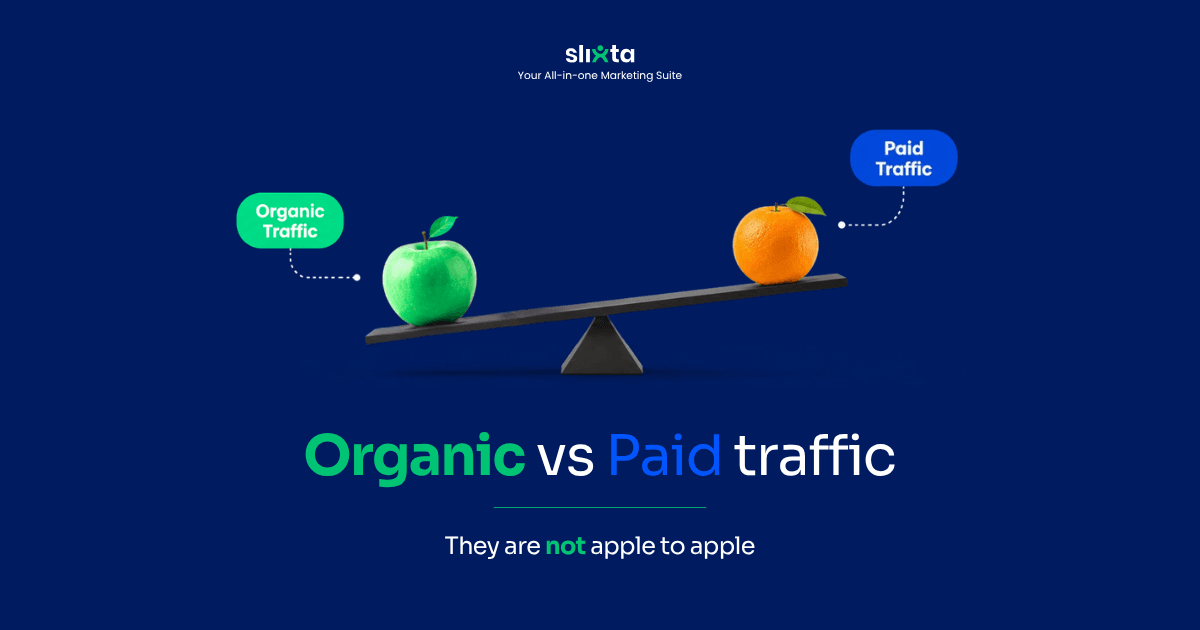
Organic and paid traffic serve different purposes. Paid gives you speed and control, while organic builds trust and reveals what your audience chooses to engage with.
Most marketing teams treat organic and paid as two levers for the same outcome: reach. They pick whichever lever moves faster. Paid moves faster. So paid wins the budget meeting, every time.
But "faster" and "better" are not the same word. And conflating them is how a lot of otherwise smart B2B marketing teams end up running on a treadmill: spending more every quarter just to stand still.
Why This Question Keeps Coming Up
"Why bother with organic if a small ad spend gets you the same reach?"
It's a fair question. Most of us don't have a good answer for it, because on paper, paid looks unambiguously more efficient. You set a budget, you pick an audience, and the platform delivers the numbers. Organic is slower, less predictable, and dependent on an algorithm deciding, on that particular day, that your content deserves distribution.
So why not just skip it?
Because reach was never the thing that mattered. Trust was. And paid reach and organic reach produce two completely different kinds of trust, because they're built on two completely different kinds of attention.
Paid puts you in front of the audience you selected. Organic puts you in front of the audience that chose to engage. One is rented attention. The other is earned attention.
Why Both Matter More in High-Consideration Sales
The longer the buying cycle, the less useful it becomes to think of marketing as simply a race for reach.
If you're selling a $19 impulse product, paid can do a lot of the work. The decision is quick, the risk is low, and the buyer does not need much convincing.
But when you're selling software, consulting, logistics, financial services, or anything that requires internal approval and multiple stakeholders, the buying process is different. Buyers research, compare, revisit, and build confidence before they ever talk to sales. That makes repeated, useful exposure far more valuable than a single impression.
This is where organic and paid serve different purposes:
- Paid gives you speed, control, and predictable distribution. It gets you in front of the right person.
- Organic earns attention and builds familiarity over time. It gives that person a reason to keep paying attention.
Neither is inherently better. They solve different parts of the same problem.
There Is No Universal Starting Point
The right sequence depends on what your business needs at that moment.
A new company entering an unfamiliar market may start with paid to reach a defined audience quickly, test demand, and gather initial data. Another company with an established audience may have enough organic traction to identify what resonates before using paid to amplify it.
The point is not to always start with organic or always start with paid.
Start with the channel that answers your most important question, then use what you learn to inform the other.
If paid tells you which audience responds, organic can help build deeper familiarity with that audience. If organic shows that a message consistently earns attention, paid can help scale it. One can create the initial signal, while the other helps build on it.
The strongest approach is not choosing a winner. It is knowing what each channel is supposed to accomplish, and knowing when to move from one to the other.
How They Actually Behave
What You're Really Buying
- Organic: Attention that has to be earned each time
- Paid: Attention you can command on demand
What Happens the Moment You Stop
- Organic: Existing content can continue generating attention
- Paid: Paid distribution largely stops
What a Result Actually Proves
- Organic: The message resonates on its own
- Paid: The audience was reachable at that price
What You Get When You Combine Both
Used together, deliberately, organic and paid stop competing for credit and start doing different parts of the same job:
- Organic becomes your testing ground: showing you which content, offers, and messages earn attention without spend
- Paid becomes your amplifier: taking what's already proven and putting it in front of more of the right people, faster
- Your cost per lead drops over time: because paid campaigns are built on messaging that's already validated, not guessed at
- Your brand builds equity that survives budget cuts: because organic keeps working even in months when paid spend is paused
- Your buyers experience a consistent brand: the message they saw organically is reinforced, not contradicted, by the ads they see later
That combination, tested by organic and scaled by paid, is what actually compounds. Neither channel alone gets you there.
Why You Need Visibility Into Both
Using organic and paid together only works when you can see how they influence each other.
If organic performance, paid campaigns, LinkedIn prospecting, and outbound activity live in separate tools, the signals stay fragmented. A post might show strong engagement, but the team may not notice it until weeks later. A paid campaign might reveal a promising audience, but that insight may never make its way back into the organic strategy.
That is where Slixta fits in.
The goal isn't to choose between organic and paid. It's to make the signals from both visible enough to act on them together. When campaign performance, prospecting activity, and organic engagement can be viewed in one place, a useful signal does not have to wait for the next reporting cycle to become a decision.
The Real Takeaway
Organic and paid aren't competing channels. They solve different problems.
Paid gives you speed and reach. Organic builds familiarity and reveals what your audience chooses to engage with.
The smartest teams don't pick a winner. They use what one channel teaches them to make the other more effective.
The question isn't organic or paid. It's what each is doing for you right now, and what you do with that signal next.