
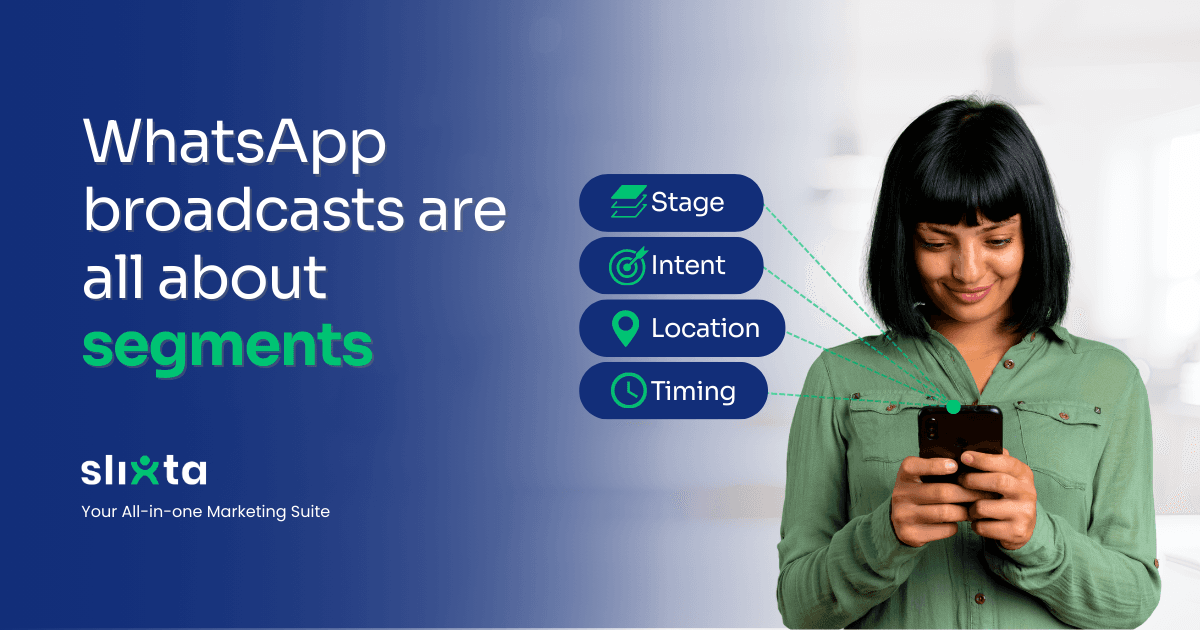
WhatsApp broadcasts work best when built on clear segments. The right message to the right audience drives higher engagement, stronger responses, and fewer ignored messages.
What’s not an email,
not a billboard,
not a social post,
not a push notification…
but gets opened faster than all four?
It’s WhatsApp.
And broadcasting on WhatsApp is like holding a sharp blade. In the wrong hands, it cuts trust, attention, and patience. In the right hands, it’s a precision tool carving relevance, timing, and connection into every message.
The Illusion of Reach
Broadcast numbers can be deceptive.
A list of 50,000 contacts feels powerful. The “sent” tick feels productive. The dashboard says your message went everywhere. But reach without relevance is just digital clutter dressed up as performance.
This is the illusion many marketers fall into: confusing distribution with impact.
On channels like billboards or traditional media, wide reach was the goal because personalization was impossible. WhatsApp changed that equation. It gave brands access to a space designed for one-to-one communication yet many still use it with a one-to-many mindset borrowed from old advertising.
In modern marketing, influence isn’t created by how far a message travels. It’s created by how accurately it lands.
Segmentation is what closes the gap between sending and connecting
Why Segmentation Determines Outcomes
Segmentation isn’t just a digital tactic. It’s rooted in one of the most enduring frameworks in marketing: the STP model Segmentation, Targeting, Positioning.
The sequence matters.
First, marketers divide audiences into groups based on shared behavior, needs, or buying stage. That’s segmentation. Then they evaluate those groups and decide which segments the business will actively serve and invest in. That’s targeting. Finally, they shape messaging to match what that segment values most. That’s positioning.
WhatsApp broadcasts are where this framework becomes operational. Every message you send is a positioning decision. You are either aligning with a segment’s context or ignoring it.
Marketing thinker Philip Kotler famously noted:
“The key to winning customers is to understand their needs and deliver superior value.”
Understanding needs at scale is impossible without structured segmentation. WhatsApp doesn’t reduce the importance of this principle, it magnifies it. The platform exposes whether a brand truly understands its audience, because messages arrive in a space people treat as personal.
Segmentation allows marketers to allocate attention intelligently instead of evenly.
From Theory to Execution: What Segmentation Actually Means on WhatsApp
On WhatsApp, segmentation is not just demographic filtering but It’s behavioral mapping.
The most effective broadcast strategies don’t divide audiences by surface-level attributes. They organize communication around stage, intent, location, and timing.
A first-time inquiry should not receive the same message as a repeat buyer.A high-intent prospect who recently clicked on pricing should not be treated like someone who casually joined an awareness campaign.
A user in a different geography may require contextual relevance.And timing matters a message sent weeks after the last interaction carries a different weight than one sent within hours of expressed interest.
This is where most broadcast strategies fail. They segment by convenience rather than by context.
But context is what makes WhatsApp powerful.
So what is the difference between sending a message and continuing a conversation?
For example, consider a user who clicked on a pricing ad, opened the brochure link, but didn’t respond further.
A generic broadcast would say: “Limited-time offer. Book now.”
A segmented broadcast would say: “Still evaluating pricing? Here’s a quick breakdown of plans based on team size.”
The difference is subtle but structural. The second message responds to behavior. It signals awareness and context. It respects where the user is in their decision process.
Making this possible requires more than a contact list. You need a system that remembers where a contact came from, what they interacted with, and how recently they engaged. You need labels or tags that update when someone clicks, replies, or goes silent. And you need segments that adjust automatically as behavior changes, instead of relying on manually exported lists.
Brands like Amazon don’t succeed on messaging platforms because they send more messages. They succeed because their communication reflects browsing behavior, purchase history, and real-time intent
Broadcasts work not because they are sent, but because they are aligned.
The Infrastructure Behind Intelligent Broadcasting
Alignment sounds simple. In practice, it requires connected systems.
Most brands already collect signals - ad clicks, landing page visits, chat replies, campaign sources. The problem isn’t lack of data. It’s fragmentation. Information lives in separate dashboards, and when systems don’t connect, segmentation becomes manual. Lists are exported. Tags fall behind behavior. Broadcasts rely on outdated assumptions and on WhatsApp, irrelevance is immediately visible.
Intelligent broadcasting depends on three structural shifts:
First, contacts must carry context. Campaign source, entry point, and initial intent should stay attached to the user.
Second, behavior must update status. Replies, clicks, and inactivity should automatically influence how and when the next message is sent.
Third, segments must stay dynamic. Static lists decay. Real audiences evolve.
Without that structure, even the best segmentation strategy collapses at execution.
This is exactly where Slixta operates.
Slixta captures lead data from ads, landing pages, forms, and WhatsApp conversations, consolidating it into a unified CRM. Every contact carries its source, interaction history, and engagement signals in one evolving profile.
Segmentation becomes dynamic, not manual.
Contacts are grouped based on source, interest, clicks, replies, or stage in the buying journey. A pricing viewer is treated differently from an awareness-stage lead. An active conversation is separated from a dormant contact. High-intent prospects are distinguished from early-stage inquiries.
As behavior changes, segments update automatically. Broadcasts are sent based on live intent signals not static lists.
For marketers, this isn’t just efficiency. It’s control.
Control over who receives what. Control over timing. Control over relevance.
The difference between volume and value is infrastructure and that’s where Slixta comes in