
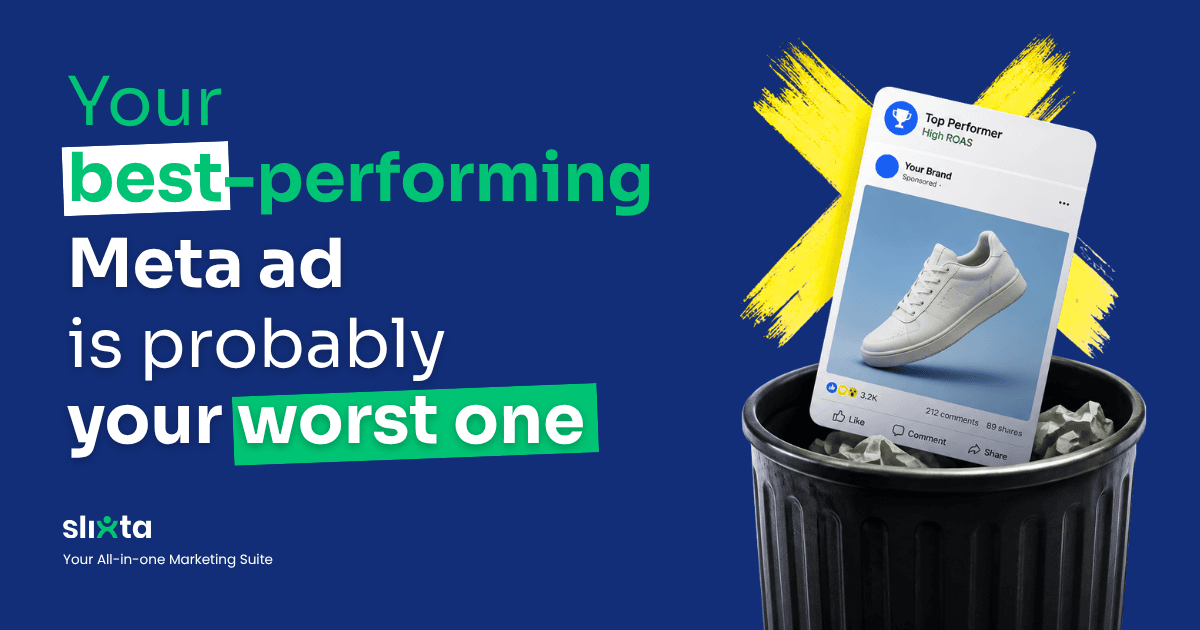
The best-looking Meta ad can sometimes deliver the weakest business results. Optimizing only for clicks and leads often hides what actually drives real customers and revenue.
Do you know what is the most dangerous thing in marketing ?
It’s not poor performance.
It’s misleading performance.
Because it convinces you that things are working. It gives you numbers that look right, trends that feel positive. And while you keep investing more into what seems like success, the actual business outcome quietly moves in the opposite direction.
This is exactly what happens with many of the most celebrated metrics in performance marketing today
The real problem: confusing activity with business outcomes
Most marketing dashboards are built around what we can easily see: clicks, impressions, and cost per lead (CPL). These are useful but only to a point.
They are activity metrics.
Activity metrics tell you what people are doing:
- They clicked
- They filled a form
- They became a lead
But they don’t tell you what actually matters to a business.
Business metrics go one level deeper:
- Did that lead become a customer?
- How much did it cost to acquire that customer (CAC)?
- How much revenue did they generate?
Here’s the uncomfortable truth: You can improve activity metrics while hurting business performance.
Once you start celebrating CPL without connecting it to customers, you’re not measuring success, you’re measuring movement.
And that leads us to the next mistake.
When the “winner” is actually losing you money
Let’s make this real with a simple example.
Two campaigns running on Meta:
Campaign A
- Cost per lead: ₹180
- Leads generated: 240
- Customers closed: 4
Campaign B
- Cost per lead: ₹900
- Leads generated: 38
- Customers closed: 11
At first glance, Campaign A looks like a clear winner. Lower CPL, higher volume.
But now calculate what actually matters - cost per customer:
- Campaign A: ₹180 × (240 ÷ 4) = ₹10,800 per customer
- Campaign B: ₹900 × (38 ÷ 11) ≈ ₹3,109 per customer
Suddenly, everything flips.
The “best” ad is actually costing more than 3x to acquire a customer compared to the “worst” one.
So what went wrong?
Campaign A optimized for ease. It attracted more people but most of them were not serious buyers. Campaign B had fewer leads but stronger intent.
This is the hidden layer most dashboards never show you.
And to understand why this happens consistently, we need to talk about friction
High friction is not a flaw. It’s a filter.
Friction in marketing has been misunderstood for a long time. It’s often treated like a leak in the funnel, something to eliminate as quickly as possible.
But not all friction is bad. Some friction is doing the job of qualification before your sales team even gets involved.
Let’s take a more realistic scenario.
A premium interior design firm runs two lead campaigns:
- One ad says: “Get a free design consultation.”
- Another says: “Projects starting at ₹10L. Book a consultation.”
The first campaign explodes with leads. Students, early-stage homeowners, casual browsers, everyone signs up. The CPL looks fantastic.
The second campaign performs “worse.” Fewer people click. Even fewer fill the form. CPL is significantly higher.
But when sales start calling, the difference becomes obvious.
The first campaign creates volume but most conversations go nowhere. Budget mismatches, low urgency, or just curiosity.
The second campaign creates alignment. The people who come in already understand the price range, the commitment, and the seriousness required.
One creates leads.
The other creates buyers.
That difference is friction.
Friction is what sets expectations before the conversation begins. It answers questions early. It filters out people who were never going to convert in the first place.
And the most important part it protects your downstream efficiency:
- Sales teams spend less time qualifying
- Conversion cycles become shorter
- Close rates improve
So when CPL increases because of friction, it’s not inefficiency, it's pre-qualification happening earlier in the funnel.
The algorithm is not wrong. You are just asking the wrong question.
Platforms like Meta are incredibly effective at optimization.
But they can only optimize for what you tell them.
If your goal is “generate leads,” the system will do exactly that: find the cheapest, fastest way to get more people to fill out a form.
It doesn’t know your margins. It doesn’t sit in your sales calls. It has no context of what happens after a form is filled.
So it keeps pushing toward lower-cost leads even if their quality drops over time.
And here’s where the real operational issue shows up.
- Ads are tracked on Meta
- Conversations happen on WhatsApp
- Sales outcomes sit with your team
- CRM data is incomplete or delayed
The most important insight which leads actually become customers never makes it back into your campaigns.
This is the gap that platforms like Slixta are built to solve.
Not by giving you more metrics, but by connecting the ones that already exist.
When you can clearly see:
- Which ad brought the lead
- What happened on WhatsApp
- Whether that lead converted into revenue
You stop optimizing for form fills.
You start optimizing for actual customers.
Without this connection, your strategy will always be limited. Because no matter how good your ads are, you’re training the system on incomplete information.
One last question
So ask yourself again:
Is your best-performing Meta ad actually your worst one?
Because if you can’t trace a lead all the way to revenue through WhatsApp, through sales, through actual conversion then you’re still making decisions on half the story.
And half the story is expensive.
Stop settling for half the story and start using Slixta to connect your Meta ads to real revenue, ensuring you never mistake simple activity for actual business growth