
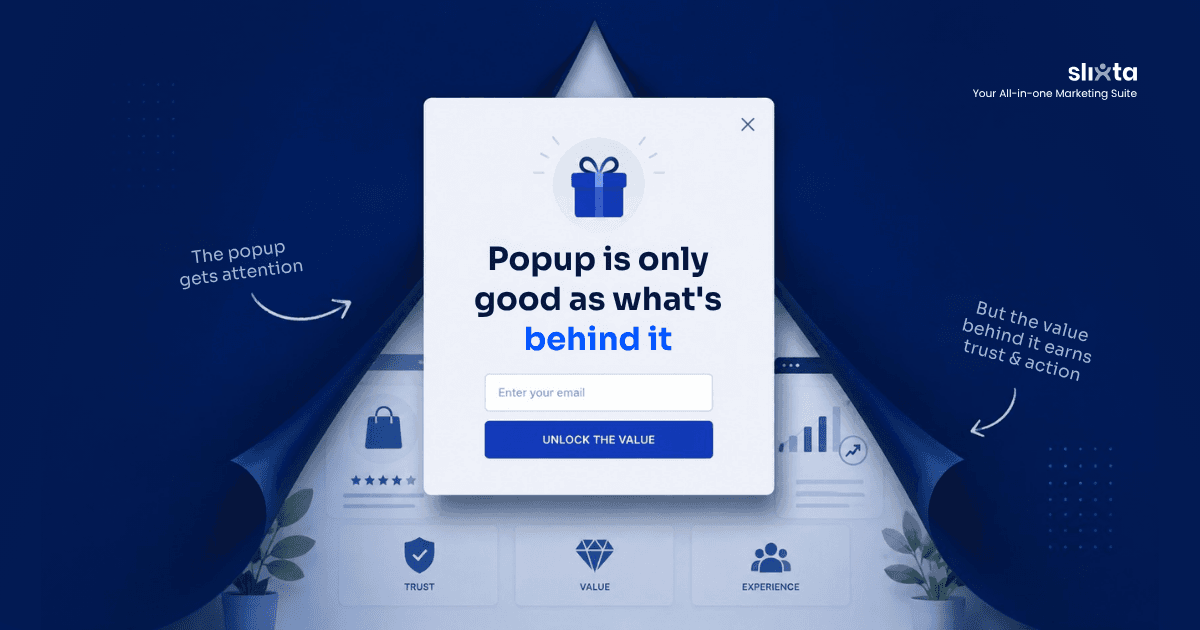
Most popups don't fail because they interrupt visitors. They fail because the offer behind them isn't compelling enough. A popup should capture existing intent with something genuinely useful, then trigger an immediate, relevant follow-up before that intent fades.
For centuries,Street vendors understood something that digital marketers often forget:
Give people a reason to stop before asking them to buy.
A piece of fruit to taste. A sip of tea. A small demonstration of value with no commitment attached.
The sample wasn't a gimmick. It was proof.
the invitation only works if what's behind it is worth accepting. Nobody stops because someone is calling out to them. They stop because what's being offered is genuinely hard to walk past.
Website popups were supposed to work the same way.
Instead, most ask for an email in exchange for a generic PDF that nobody wanted in the first place.
The popup isn't the problem.
The lead magnet is.
So What Is a Popup, and Why Does It Exist?
A popup is a triggered overlay that appears while someone is browsing your page. It interrupts the scroll to ask for something, usually a contact detail, in exchange for something else.
The logic was always sound. Someone is already on your page, already interested. Give them a reason to identify themselves and you turn an anonymous visit into a real conversation.
Because the internet has trained people to close popups in under a second. Their hand moves before their brain even reads the words. The only thing that slows that reflex is an offer so specific, so immediately useful, that stopping feels smarter than closing.
That is the real job of a popup. Not to interrupt. To earn the pause.
The Offer Is the Strategy
There's a reason window displays exist in retail. Not to decorate the street, but to make a promise about what's inside. A beautifully dressed window that opens into a chaotic, generic store doesn't bring customers back. It brings disappointment. The window did its job. The store didn't.
Lead magnets fail the same way.
Most of them promise value and deliver content. A generic checklist that applies to everyone and therefore nobody. A "free consultation" that is really a sales call with better branding. A guide so broad it could have been written for any industry, in any country, on any Tuesday.
The visitor sees through it in under a second, because they have seen it before, in six other tabs, this week alone.
What earns a click is something genuinely different. A lead magnet earns a click when it gives the visitor something they would have paid for, for free, at the exact moment they needed it.
A med spa offering a treatment comparison guide for the specific procedure someone had been reading about. An insurance brand offering a coverage gap checker that shows precisely what a current policy is missing. A mortgage company offering a calculator tied to the exact decision someone was already trying to make.
These aren't content pieces. They are decisions made easier, right now, by you.
That specificity is what makes someone type their number in.
And when the offer is that good, the popup stops feeling like an interruption. It feels like the page read their mind.
What the Click Actually Tells You
Here's what most businesses miss even when the lead magnet works.
The download is not the outcome. It's the signal.
What someone chooses to request tells you more about where they are in a decision than any form field you could ever add. The specific thing someone asked for already tells you what problem they are trying to solve and how close they are to making a move.
Did they request the comparison guide or the pricing breakdown? Did they use the checker once or come back to it? Did they download and disappear, or did they click through to the next page right after?
Each action narrows the picture. The lead magnet self-qualifies, so the follow-up doesn't have to guess.
Which is exactly why the offer and the system behind it have to be built together, not as two separate projects handed to two separate teams.
The Hidden Cost of a Brilliant Offer With a Broken System
A great lead magnet attached to a generic follow-up sequence is one of the most expensive mistakes in marketing. Not because it fails loudly. Because it fails quietly, and the numbers look fine until someone starts asking the right questions.
The visitor requested the coverage gap checker. They were close.
The follow-up they received was a welcome email, then a newsletter three days later, then a promotional offer for something they never asked about.
By the time a sales rep reached out, eight days had passed.
The intent that was alive when they clicked had quietly cooled off. Not because the lead was bad. Because the system treated a warm, specific signal like a cold, generic contact.
The offer created the moment.
The system let it expire.
The Popup Was Never the Hard Part
Building an offer specific enough to be irresistible takes clarity about what your visitor is actually trying to decide, not just what your product does.
And building a system sharp enough to act on what that offer learns, one that routes the right signal to the right person at the right moment, that is where the revenue actually lives.
Slixta is where both of those things exist together.
The lead magnets, conversion tools, popups, and landing pages are built inside the same platform as the CRM, the follow-up automations, and the unified reporting. So the moment someone downloads, the system already knows what they asked for, what page they were on, and what the logical next step is. Not eight days later. Not after a manual export into a separate tool. Now, while the intent is still warm.
And because it is one platform, the signal never gets lost between the marketing side and the sales side. The rep who picks up the lead can already see what the visitor did before they raised their hand.
The popup was never the hard part.
Building an offer worth stopping for, and a system that knows exactly what to do the moment someone does, that is the work.
One screen. One signal. No moment wasted.