
Buyers no longer move through fixed funnels. They explore, compare, pause, and return when timing aligns, making behavior-driven nurture far more effective than rigid sequences.
Getting attention is easy today - thanks to the internet. Everything gets seen, scrolled past, paused on for a moment, or noticed in some form. That attention can even turn into interest with the right message, the right hook, or the right trigger that makes someone curious enough to explore further.
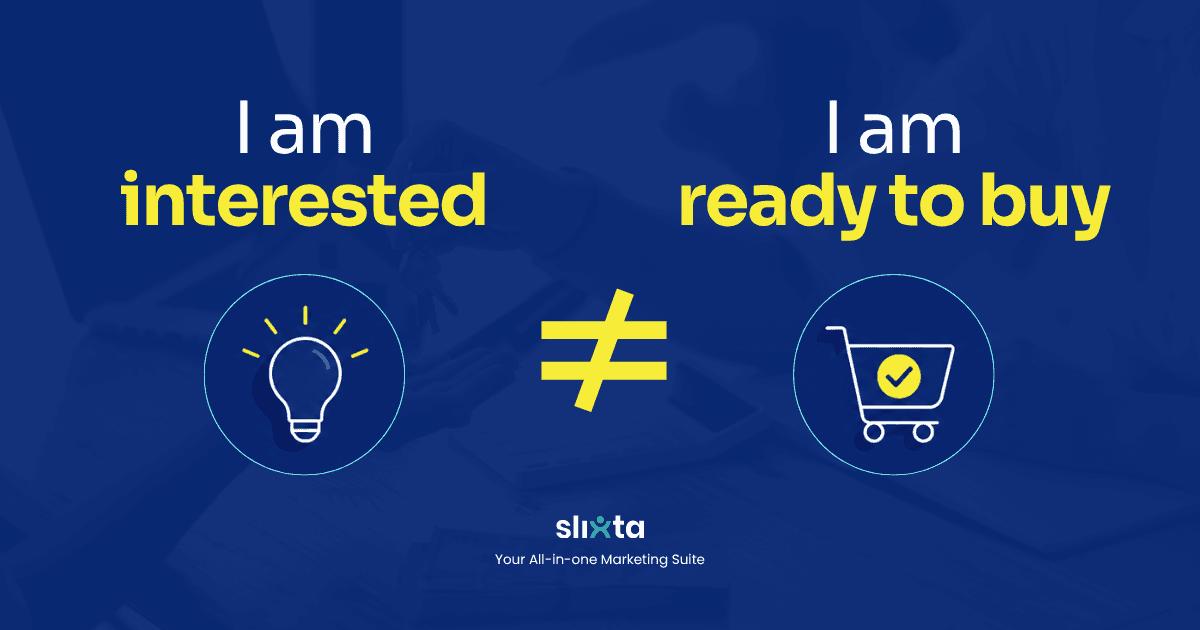
But intent is different. There is a strong difference between being interested and being ready to act and most marketing systems still treat them as the same stage, even though they are driven by completely different forces.
The core mistake is confusing an external trigger with an internal one.
Interest is driven by external triggers. It is a reaction to outside stimulus like a scroll-stopping headline or a breaking news notification that makes you pause
Intent is driven by internal triggers. It is governed by real-world necessity, budget timelines, and urgent operational needs. It is a non-negotiable readiness to move forward.
In this blog, we’ll explore what really changes between interest and intent.
The Funnel Is Not Broken. Buyer Behavior Changed.
For decades, marketing frameworks like AIDA Awareness, Interest, Desire, Action - shaped how businesses understood customer journeys. The assumption was straightforward: attract attention, build interest, create desire, and eventually drive conversion.
And for a long time, that model worked reasonably well because customer behavior itself was more predictable.
But digital behavior changed faster than funnel strategy did.
Today’s buyers do not move progressively toward decisions anymore. They research independently, compare silently, revisit brands unpredictably, consume content across platforms, pause decisions midway, and often return only when timing internally aligns.
Especially in B2B and high-consideration purchases, decision-making is rarely immediate. Multiple stakeholders influence outcomes, priorities shift suddenly, and buyers spend significant time validating choices before ever speaking to sales.
As psychologist Barry Schwartz explored in The Paradox of Choice, more options do not necessarily make decisions easier; they often increase hesitation, comparison, and decision fatigue. Modern digital environments amplify this effect dramatically. Buyers today are surrounded by endless information, alternatives, reviews, opinions, and competing narratives at every stage of the journey.
The funnel therefore is not broken.What changed is buyer behavior.
Modern funnels are increasingly behavioral rather than linear. And this is exactly where most businesses struggle.Because while buying behavior evolved, many nurture systems still operate like every lead moves through the same fixed sequence.
The Gap Between Interest and Intent
Interest is curiosity.
Intent is readiness.
You need both for a conversion to happen. Without interest, there is no entry into the funnel. Without intent, there is no purchase. On paper, it looks like a simple progression from one to the other.
But in reality, there is a gap between the two.
That gap is where most funnels quietly lose momentum.
Because interest can be created quickly today. A strong ad, a piece of content, a webinar, or even a single scroll-stopping post can make someone aware and curious. But intent does not form at the same speed. It develops slowly through context, timing, internal discussions, comparison, and perceived urgency.
This space between “I’m curious” and “I’m ready” is not empty. It is active. Buyers are still evaluating, but they are not always visible. They are consuming content silently, revisiting pages without action, comparing alternatives, and waiting for the right trigger to move forward.
This is exactly where nurture comes in.
Nurture is the bridge between interest and intent.
But this is also where many systems go wrong. Instead of bridging the gap, they overwhelm it. Follow-ups become rigid. Messaging becomes repetitive. Every signal is treated the same way, regardless of timing or context.That’s where nurture stops feeling like guidance and starts feeling like pressure.
As Howard Gossage once said, “People read what interests them.”
In the same way, buyers respond not to frequency, but to relevance. They move forward when communication aligns with what they are actively thinking about not when a system decides it is time for another touchpoint.
Effective nurture doesn’t force intent.
It recognizes where the buyer is, respects the gap between curiosity and commitment, and responds with timing and relevance that actually helps the decision move forward.
Why Most Nurture Systems Fail
Most nurture systems break for three reasons: fragmented channels, ignored signals, and delayed timing.
Fragmented Channels
Today’s customer journey happens across email, LinkedIn, WhatsApp, paid ads, websites, webinars, communities, and CRMs simultaneously.
But internally, most businesses still operate these systems in isolation.
Marketing sends emails. Sales tracks CRM updates. Performance teams optimize campaigns. Support manages conversations.
The customer, however, experiences all of it as one relationship.
When communication lacks continuity, trust weakens. A lead engaging deeply on one channel should not feel invisible on another. Platforms like Slixta address this by creating connected engagement environments where customer movement across channels becomes visible instead of fragmented.
Because disconnected communication is not a tooling issue anymore. It is a revenue issue.
Signals Are Ignored
Modern businesses have more customer data than any generation before them, yet most of it goes unused.
Someone visits the pricing page three times.Watches 80% of a webinar.Replies to a campaign.Reopens an old email after weeks.
And nothing changes downstream.
The system keeps pushing the same generic nurture flow as though no behavior occurred.
This is where most funnels quietly collapse.
The strongest marketing infrastructures today are not the loudest; they are the most responsive. They detect intent shifts early and adapt communication accordingly. That is why signal-driven engagement systems like Slixta are becoming increasingly critical for modern growth teams as they turn intent signals into immediate, context-aware engagement instead of letting them sit passively in dashboards
Because personalization is no longer about using someone’s first name in an email. It is about reacting intelligently to behavior.
Timing Is Still Calendar-Driven
Most businesses still nurture based on schedules rather than readiness.
Weekly newsletters. Fixed drip campaigns. Monthly outreach cadences.
But buyers do not operate according to marketing calendars.
Intent has a short half-life. A prospect actively researching solutions today is exponentially more valuable than the same lead two weeks later after momentum disappears.
The problem is not frequency. The problem is timing precision.
Modern nurture requires systems that react when intent spikes, not when the calendar says it is time to send another email. Infrastructure like Slixta naturally does this by shifting engagement from calendar-based outreach to behavior-triggered timing, ensuring communication happens when intent is actually active, not when the sequence says it should.
Interest Gets the Look. Intent Gets the Check.
Interest gets them to look, but intent is what gets you paid and you need both to scale a pipeline. True competitive advantage belongs to the teams that can manage the transition from initial curiosity to full commitment without breaking the connection. Stop fighting modern buyer behavior with outdated, linear funnels. Slixta is built to capture that initial spark of interest and automatically orchestrate the precise, signal-driven nurture required to build real intent.
Own the complete behavioral loop from spark to contract with Slixta.