
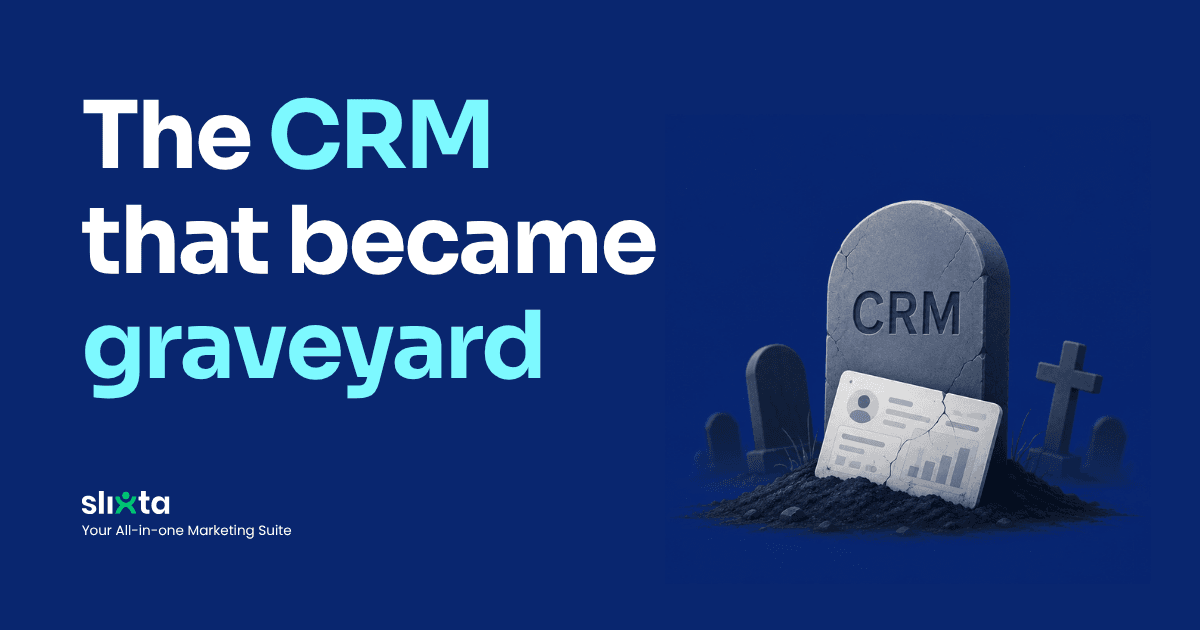
Many CRMs are built to record activity, not react to buyer intent in real time. As momentum fades between follow-ups, pipelines continue looking active even when buyers have already moved on.
Modern CRMs have mastered one thing exceptionally well:
Making dead pipelines look alive.
Everything still appears active, stages exist, reminders exist, opportunities exist, nurture flows continue running in the background.
But somewhere between “interested” and “ready,” momentum quietly disappears while the system keeps pretending the relationship is still progressing. That’s the uncomfortable disconnect modern revenue teams are starting to feel.
The dashboard says the pipeline is moving.
The reality says the buyer already moved on
To Record or React? The Modern CRM Problem.
That is the difference most systems still fail to understand:
recording buyer activity is not the same as responding to buyer intent.
And that raises an important question about the role of the CRM itself.
What was the CRM actually built for?
To react in real time to changing buyer behavior? Or simply to record what already happened?
Because most traditional CRM systems were never designed for live engagement. They were built to organize contacts, track stages, assign ownership, log activities, and maintain visibility across the sales process. In other words, they became systems of operational memory.
Modern revenue is often decided in small moments of buyer intent.
A prospect revisits your website after weeks. Someone suddenly replies after ignoring every earlier follow-up. A buyer actively starts comparing solutions because the problem internally became urgent.
Most companies think the CRM is supposed to manage these moments. But in reality, the CRM was never built to react to live intent. It was built to record that the intent happened.
And that distinction is what many modern revenue teams are finally starting to realize.
Conversation First, CRM Second
The solution is not to buy a more expensive CRM or force your team into deeper data-entry compliance. The solution is recognizing that the critical window between a lead raising their hand and a human responding lives in a live conversation, not an administrative database.
To fix the graveyard effect, high-performing growth teams are pairing their systems of record with a modern marketing stack that owns what the CRM cannot: instant capture, automated qualification, real-time routing, and immediate re-engagement.
This is exactly why native conversational channels have shifted from a customer support luxury to a core pipeline necessity. Consider WhatsApp: it is an environment where buyers actually spend their time and look at notifications. When a prospect experiences a spike in intent, catching them on WhatsApp allows you to engage them immediately, bypassing the friction of cluttered email inboxes and ignored phone calls.
By deploying intelligent conversational assistants within these channels, the dynamic changes completely:
- Instant Capture & Qualification: Instead of a form submission sitting in a queue for hours, an automated assistant instantly qualifies the buyer's budget, authority, and timeline inside a live chat wrapper.
- Dynamic Routing: If the lead is qualified and hot, intelligent bots can instantly engage, qualify further, and route the conversation to the right live human while the prospect’s attention is fully focused on your solution.
- Automated Re-engagement: If a lead goes cold, targeted broadcasts can re-spark the dialogue instantly where they are most likely to read it.
Only after this live conversation occurs does the CRM step in to do what it does best: document the milestone and record what has already moved.
Bringing Life into Cold Data with Slixta
This architectural shift is where modern digital marketing platforms like Slixta change the playbook for modern growth teams. It doesn't replace the need to keep clean historical records; instead, it ensures you actually have meaningful actions worth recording.
Slixta transforms your database from a passive archive into an active engine by layering real-time engagement channels directly over your audience segments. Instead of letting thousands of historic leads sit quietly in cold "nurture" lists, Slixta allows marketers and entrepreneurs to build intelligent conversational workflows that trigger based on live intent signals. Whether it is leveraging automated WhatsApp workflows to qualify inbound interest, or deploying smart conversational agents like bots to revive dormant opportunities.
The takeaway for modern marketing leaders and founders is clear: stop treating your pipeline as an administrative data entry project. Your CRM is an excellent historian, but a terrible closer.
By shifting to a conversation-first architecture powered by tools like Slixta, you stop building a monument to dead data and start building a live pipeline that converts
The graveyard effect does not come from bad data. It comes from delayed response. And in a world where attention is short, timing is everything.