
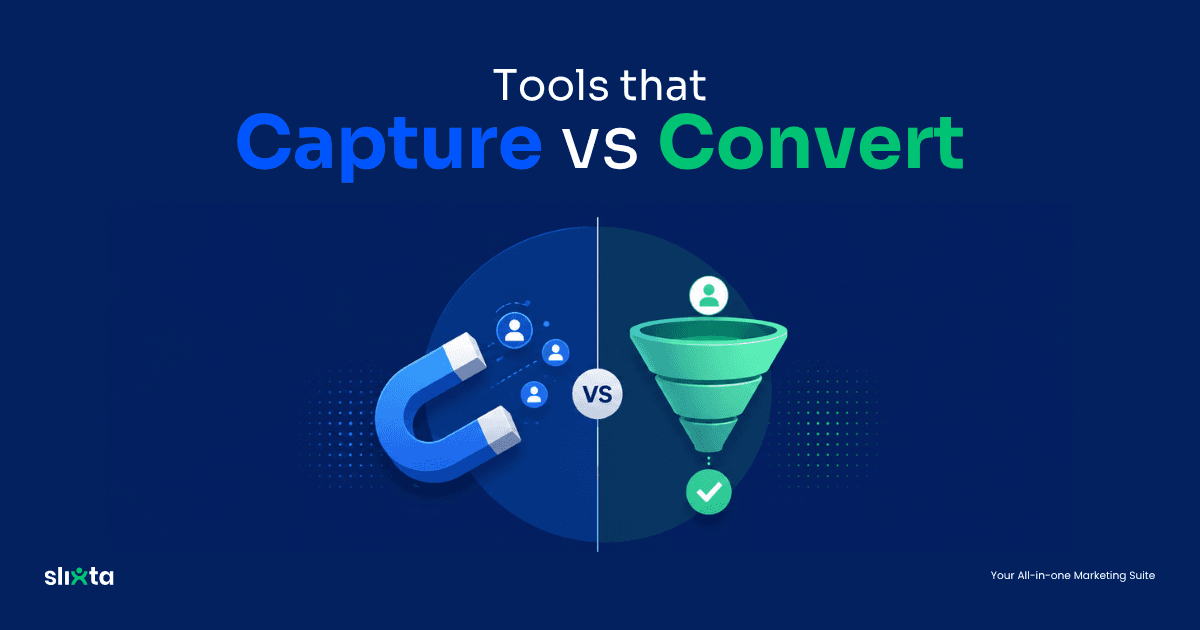
Most businesses invest heavily in capturing leads but far less in converting them. Real growth comes from responding to intent quickly, with context, before that intent fades.
In 2011, Scott Brinker published the first Marketing Technology Landscape which had 150 tools on it.By 2026, that number had crossed 14,000.
And the question nobody asked while buying most of them: are we building a machine that captures, or one that converts?
Because those are not the same machine.
The Budget Tells the Story
Walk through any B2C marketing budget and you'll find the same pattern.
Paid search, Meta ads, Landing pages, SEO, A/B testing the headline, then the form, then the button colour. All of it pointed at one outcome: getting someone to raise their hand.
Now follow that hand once it goes up.
A CRM notification. A follow-up the next morning, if someone remembers. A second attempt two days later. Then the nurture bucket - a polite word for limbo.
That's the split in a sentence: capture is everything spent getting the hand raised. Conversion is everything that happens once it is.
And the budget knows the difference even if the org chart doesn't. Capture gets a team, a strategy, a monthly review slide. Conversion gets good intentions and whoever's free enough to send a follow-up at 9am.
Why This Gap Exists
Capture is visible. You can point to impressions, clicks, cost per lead. Numbers with green arrows that are easy to show in a presentation and easy to defend when someone asks what the budget went toward.
Conversion falls into the grey area between marketing and sales. Nobody owns it cleanly. Nobody has a dashboard for it that both teams agree on. So it gets half the attention and a fraction of the budget, and the gap between what was captured and what actually closed quietly grows wider every quarter.
That is where the money leaks. Not dramatically. Gradually.
That gradual leak isn't caused by poor salespeople or weak follow-up scripts.
It exists because every lead is time-sensitive. And time is the one thing most conversion systems fail to account for.
Intent Doesn't Wait
A lead is not a record. It is a moment. And moments decay.
The person who filled your form at 2pm on a Tuesday exists in a very specific state of mind. Something prompted them. A problem they are tired of carrying. A decision they finally sat down to make. A budget that just got approved. That state of mind does not hold. It fades, gets interrupted, gets talked out of itself by the end of the day.
The Harvard Business Review found that companies responding to web leads within an hour are seven times more likely to have a meaningful conversation than those who wait longer. Not incrementally better. Exponentially.
Booking.com understood this before most companies did. The moment you browse a property and leave without booking, the system responds within minutes. A price nudge. An availability reminder. Not because they are desperate, but because they mapped the buyer's psychology precisely enough to know that silence inside the window of intent is expensive.
Signals have an expiry. Most CRMs were not built with that in mind.
If intent fades over time, then delay isn't just an operational issue.It's a measurable business cost
The Metric Most Teams Never Measure
Every marketing team can tell you their cost per lead. Maybe it's time we started tracking a different number - Cost Per Delay.
Cost Per Delay, or Intent Decay if you prefer the psychological framing. It is the value quietly lost between the moment someone raises their hand and the moment someone actually reaches them. CPL measures what you spent to get attention. CPD measures what you are losing by sitting on it.
The two metrics are not in tension, they are in sequence. A low CPL and a high CPD is not a win. It is money spent well on the front end and wasted on the back end. Until Intent Decay sits on the same dashboard as Cost Per Lead, most businesses are only measuring half the transaction.
Once you start thinking in terms of Cost Per Delay, another problem becomes obvious.
Spending more to generate leads doesn't solve a system that is already losing the ones it has.
The Paradox of More Spend
When the conversion layer is broken, more leads do not fix the problem. They accelerate it.
More leads into a slow, manual, fragmented follow-up system means more moments that decay. More intent that expires before anyone gets to it. More budget spent acquiring something the business was never structurally built to convert.
A pipe with a leak does not need more water. It needs the leak fixed first.
So if the answer isn't more traffic, what actually fixes the problem?
What the Conversion Layer Actually Requires
Conversion is not a sales function. It is a system function. The difference matters because framing it as a sales problem means waiting for better salespeople. Framing it as a systems problem means building something that does not depend on anyone remembering to follow up.
A conversion machine isn't just a CRM. It's a system that notices intent, understands context, responds immediately, remembers every interaction, and keeps the conversation alive until a decision is made.
Speed is the entry point. Responding fast signals operational readiness before a single word of conversation has happened. But speed without context is just noise arriving quickly. Contextual speed is the difference between a conversation and a conversion.
Context is what turns a fast response into a real one. A follow-up that knows what someone downloaded, which page they spent the most time on, and what they were comparing before they submitted their details does not feel like a cold outreach. It feels like a continuation of something the visitor already started. That shift in how the follow-up is received changes everything about whether the conversation progresses.
This is where a new generation of marketing platforms is emerging.
Instead of treating lead capture, CRM, follow-up, and behavioural context as separate systems, they bring them into one workflow.
Slixta is built around that idea. The lead capture, the routing, the context from every page visit and download, and the follow-up sequence all live inside one system. So the moment someone raises their hand, the response already knows who they are and what they were looking at. Not assembled manually by someone cross-referencing three tools the next morning. Automatically, while the intent is still warm.
Responding quickly is only the beginning.
Not every buyer makes a decision after the first conversation. Which means a conversion system also needs a way to bring dormant intent back to life.
Re-engagement is the most overlooked piece of all. Not every lead closes on first contact. A lead that goes quiet is not dead. It is dormant. And dormant leads without a structured re-engagement sequence are revenue sitting in a field that nobody went back to harvest.
Fix the Conversion Layer First
Most businesses have built a beautiful door. The ad is polished. The landing page converts. The form works. And then visitors walk through, raise their hand, and stand in a half-empty building waiting for someone to arrive.
The capture problem is largely solved. Fourteen thousand tools and a generation of performance marketers have made sure of it. The conversion problem is where the next decade of revenue is hiding.
Build the machine that earns the second step.
The most expensive lead in your pipeline is not the one that was hard to acquire. It is the one that was ready to close and nobody got there in time.