
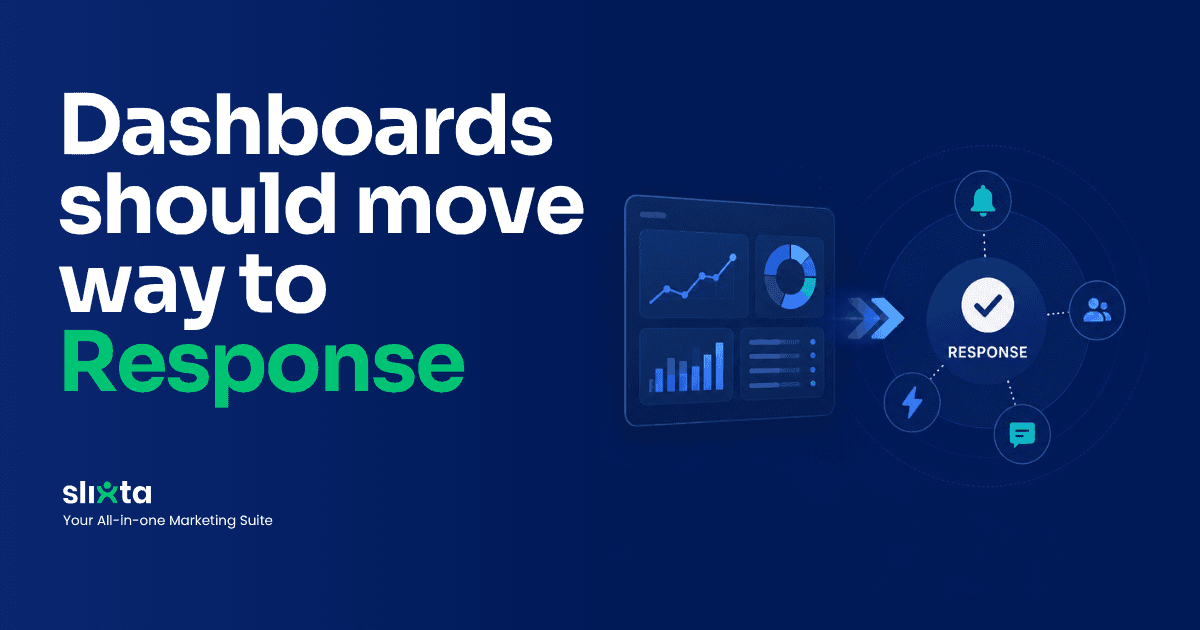
Dashboards create visibility, but visibility alone does not drive growth. Modern marketing advantage comes from responding to customer intent quickly while attention and urgency are still active.
There is a quiet crisis happening inside the modern marketing stack, hidden behind the comforting glow of executive dashboards. Teams spend months engineering complex data pipelines to achieve total visibility, believing that better tracking naturally produces better outcomes. We celebrate when a platform successfully maps the entire multi-touch journey of a prospective buyer, capturing every touchpoint from discovery to intent. But while we have become masters of documenting behavior, we have inadvertently institutionalized a massive operational delay.
The core issue is that our current infrastructure treats data as a collection of historical artifacts rather than a living asset.
This disconnect highlights a deep flaw in how we measure operational readiness. Visibility is frequently mistaken for velocity, and comprehensive reporting is substituted for immediate execution.
The Goodhart’s Law Correlative: When Perfection Stifles Responsiveness
To understand why modern marketing organizations fall into this trap, one must look to an economic principle formulated by British economist Charles Goodhart, which was later famously distilled into a universal truth: when a measure becomes a target, it ceases to be a good measure. It states a simple truth: the moment a metric becomes your main goal, it ceases to be a good metric. Think of the "Cobra Effect" in colonial India. The government wanted fewer snakes, so they offered a cash reward for dead cobras. The metric was dead cobras; the goal was fewer live ones. What happened? People started breeding cobras in their backyards just to kill them and collect the cash. The metric ruined the goal.
In modern marketing, a very similar trap occurs. When a marketing team’s primary goal becomes "having a perfect, beautiful dashboard for the Monday morning board meeting," the dashboard itself becomes the target.
Suddenly, the focus shifts from winning customers to protecting data hygiene. Because real-time consumer behavior is messy and fast, teams deliberately slow things down. They pull data into large warehouses, clean it up, and wait for it to organize into neat, pretty charts.
The paradox is brutal. To make sure the report looks flawless, companies willingly introduce days of delay into their sales process. They choose to look back with absolute clarity rather than act forward with absolute speed. The dashboard stops being a tool for growth. Instead, it becomes a pristine corporate archive, a beautiful report documenting exactly how a highly motivated buyer slipped away days before anyone bothered to send a reply.
The New Competitive Advantage Is Response Velocity
For most of business history, competitive advantage came from one of three things: superior distribution, superior information, or superior capital. The internet dramatically reduced the scarcity of all three.
Distribution became digital.
Information became searchable.
Capital became accessible.
Which means modern advantage increasingly comes from something far less discussed: the speed at which an organization can convert customer intent into meaningful action.
This is not simply about replying faster to emails or automating follow-ups. It is about reducing what systems theorists call decision latency - the time between signal detection and operational response.
The companies quietly outperforming their markets today are not always the ones with the most data. In many cases, they are the ones architected to react while intent is still emotionally active.
That distinction matters because intent has a half-life.
A customer exploring pricing pages at 10:04 AM is not in the same psychological state at 4:30 PM after meetings, competing research, and digital distraction. Human attention decays quickly and so does buying momentum.
Behavioral economists call this temporal discounting - urgency weakens over time. The brands winning today understand something most dashboards cannot measure:
Speed changes perception.
A fast, intelligent response feels attentive and relevant. Responsiveness itself has become part of the customer experience.
Dashboards Create Awareness. Response Systems Create Momentum.
The problem with most marketing stacks is not that they lack intelligence. It is that intelligence arrives too late to influence outcomes.
Dashboards are fundamentally retrospective systems. They summarize patterns, explain trends, and organize historical behavior into something executives can interpret. That has value. But interpretation is not the same as intervention.
A company can know everything and still react too slowly.
This is where many organizations unknowingly fall into what sociologists describe as symbolic control system, structures that create the feeling of operational control without actually increasing operational responsiveness. The dashboard looks sophisticated, the reporting is comprehensive, and the metrics appear healthy. Meanwhile, the customer has already moved on.
Because awareness does not create momentum.
Action does.
The highest-performing marketing organizations are beginning to treat customer intent less like a reporting metric and more like a live operational event. A pricing-page revisit is no longer just an analytics insight to review later. It becomes an immediate trigger for engagement. A sudden spike in product exploration is not merely another chart movement. It is a signal demanding response while attention is still active.
This represents a deeper shift in philosophy.
Traditional marketing systems were designed to document journeys.
Modern growth systems are increasingly being designed to influence journeys in real time.
That difference changes everything.
The Next Marketing Stack Will Not Be Built Around Dashboards
For more than a decade, marketing technology evolved around a single obsession: visibility.
Every new platform promised deeper attribution, better analytics, cleaner reporting, more granular segmentation, and a clearer view of the customer journey. Entire ecosystems were built to answer one question:
“What happened?”
But the next generation of marketing infrastructure will likely be built around a very different question:
“What should happen immediately because this happened?”
That shift changes the role of the marketing stack entirely.
The CRM can no longer function as a passive database where leads wait to be reviewed later. Intent signals cannot afford to sit idle inside dashboards until the next reporting cycle. In fast-moving markets, customer intent loses value every minute it remains inactive.
Which means modern systems need to evolve from systems of record into systems of response.
This is why a new category of response-native platforms like Slixta is beginning to emerge, platforms designed not merely to capture customer behavior, but to operationalize it in real time. Instead of treating intent as something to analyze later, these systems are designed to activate engagement while attention is still alive.
A pricing-page revisit becomes a trigger, not a statistic.
A spike in product exploration becomes an opportunity, not a chart movement.
A returning visitor becomes an active conversation, not another row in a report.
This is the philosophy behind Slixta
Not another analytics layer.
Not another dashboard demanding attention.
But infrastructure built around reducing the gap between signal and response.
Because the future advantage in marketing will not belong to companies that simply collect more customer data.
It will belong to companies that can act on customer intent while the moment still exists.